After a second move in less than two years, I again live in borderlands. Not the international or continental boundaries of my childhood, but in an overlap of industrial and urban space. Situated at a confluence of rail lines, shipping canals, and a state highway, I spend time in pandemic-isolation across from a gas station and a cement terminal, looking out over drawbridges, an EPA site, and in the distance, downtown Milwaukee.
We moved with short notice just before the city shut down. Unpacking during the early days of the stay-at-home order, and so soon after the previous move, was a slightly nauseating and unexpectedly exhausting task. The new place felt alien. Just another box to live in, without surrounding greenspace, but clean at least, and with windows.
After a couple of weeks of rearranging we finally got to unpack the art–a revelation! Unwrapping, placing, and finally hanging or situating these objects brought a release and relief that was unexpected. The boxy space became a home, and not just any home, my (our) home. Luckily I am now working from this home.
While unpacking, trying to correspond via email, obsessively following shared social and news sites, participating in online meetings–both for work and for happy hours–the contact I have been making is distant, digital, and mediated. Like probably most people on the planet, I miss the physical. I look forward to again going for coffee, meeting friends for music or meals, traveling to see distant family, and visiting the grocery store without feeling on the edge of panic.
The other thing I am desperately missing is seeing art. I am a fan of physical objects. I love looking at the materials, seeing how they are worked, thinking about why the substances behave the way they do, considering what the artists were trying to accomplish, and attempting to understand just when the object moves outside of the artist’s intention and becomes something more. Some people watch movies, others go to shooting ranges. I visit galleries and museums and studios because looking at stuff makes me happy. But what is there to see when the world shuts down?
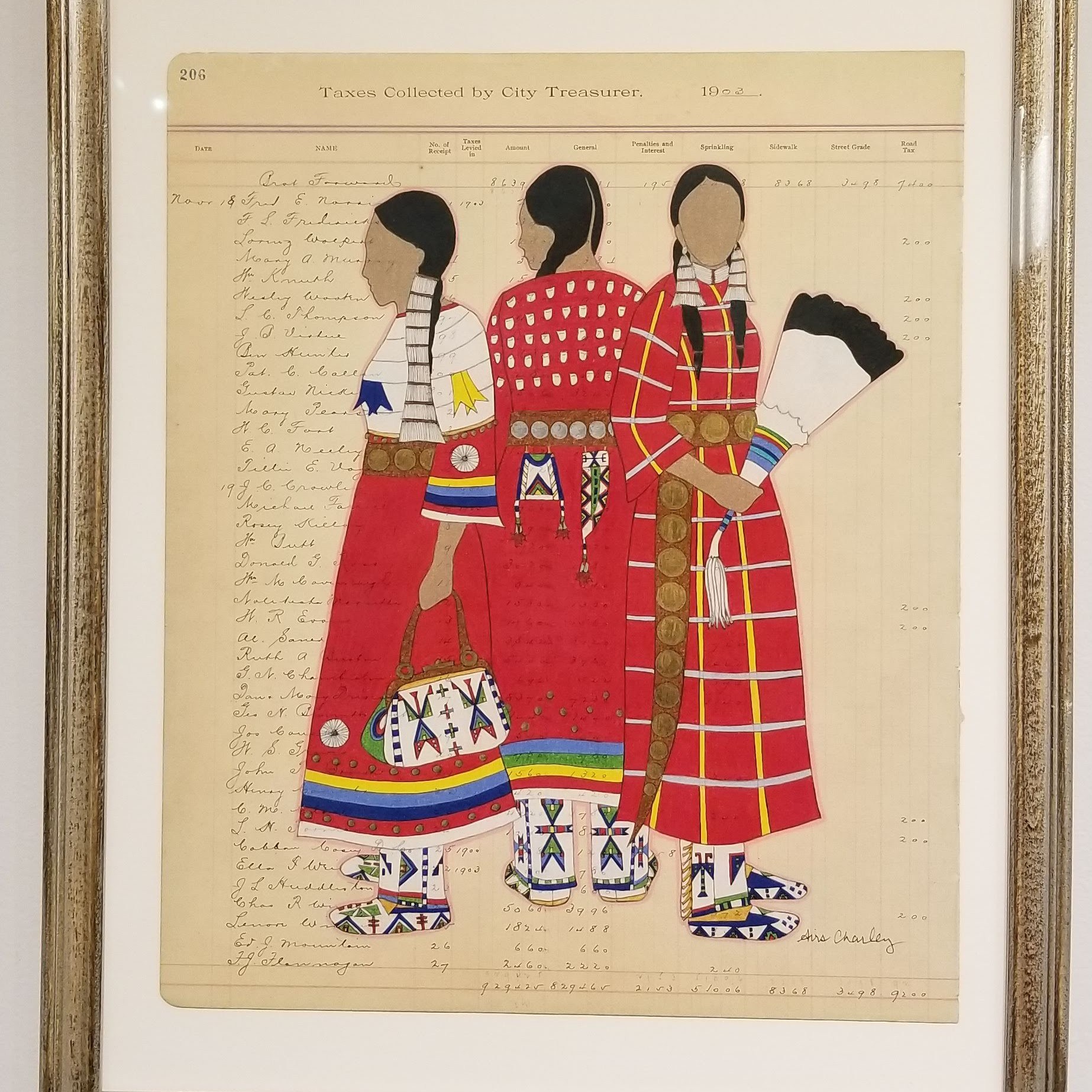
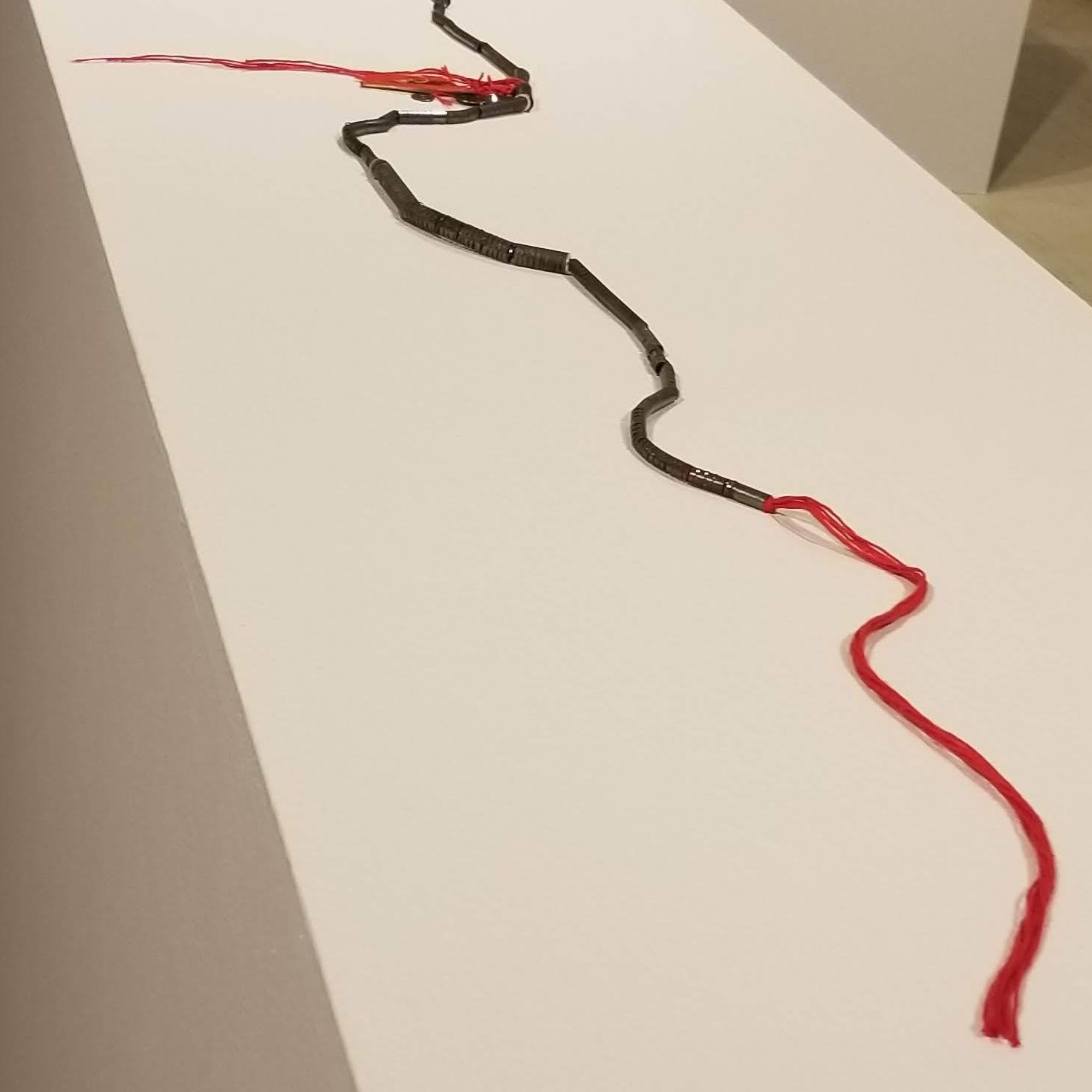
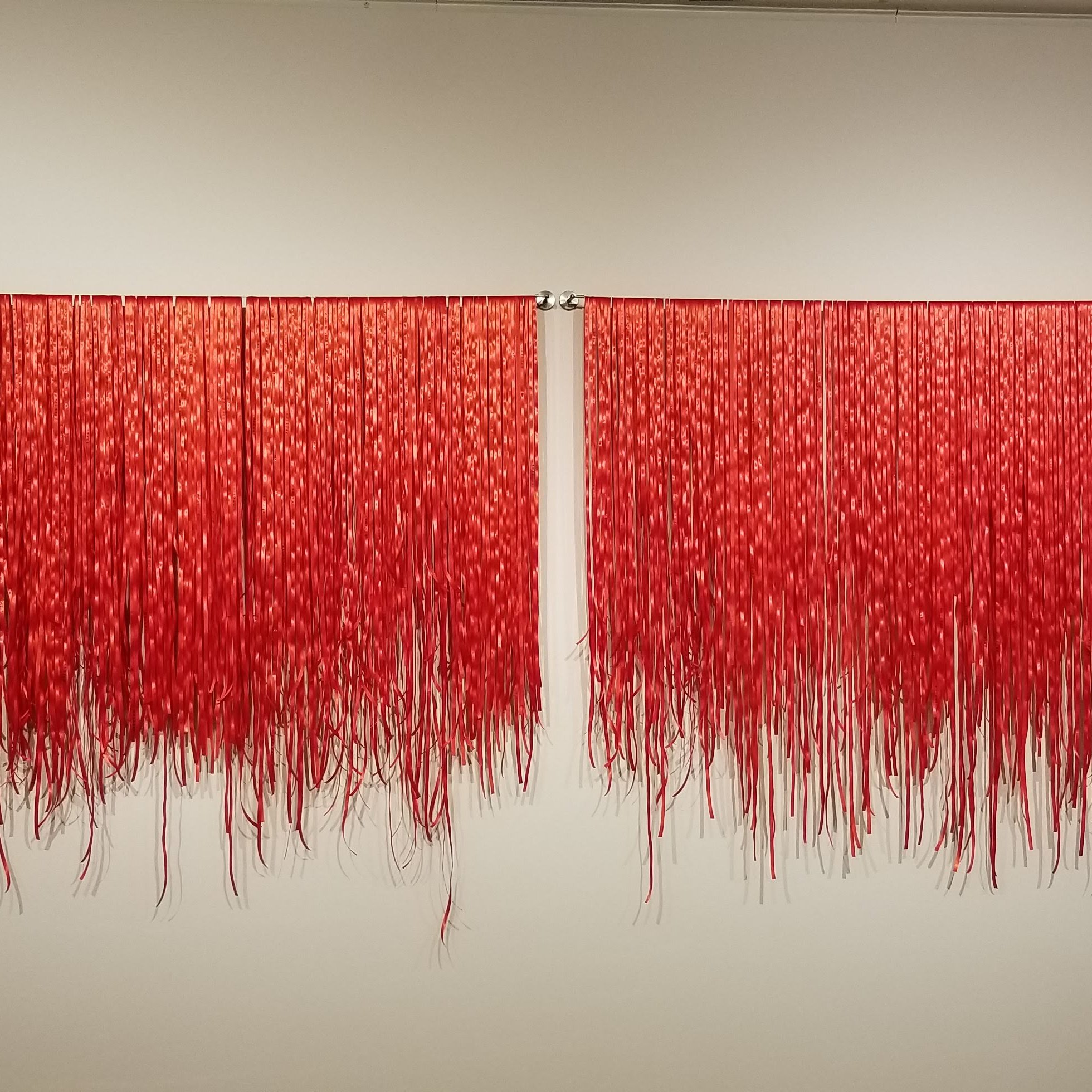
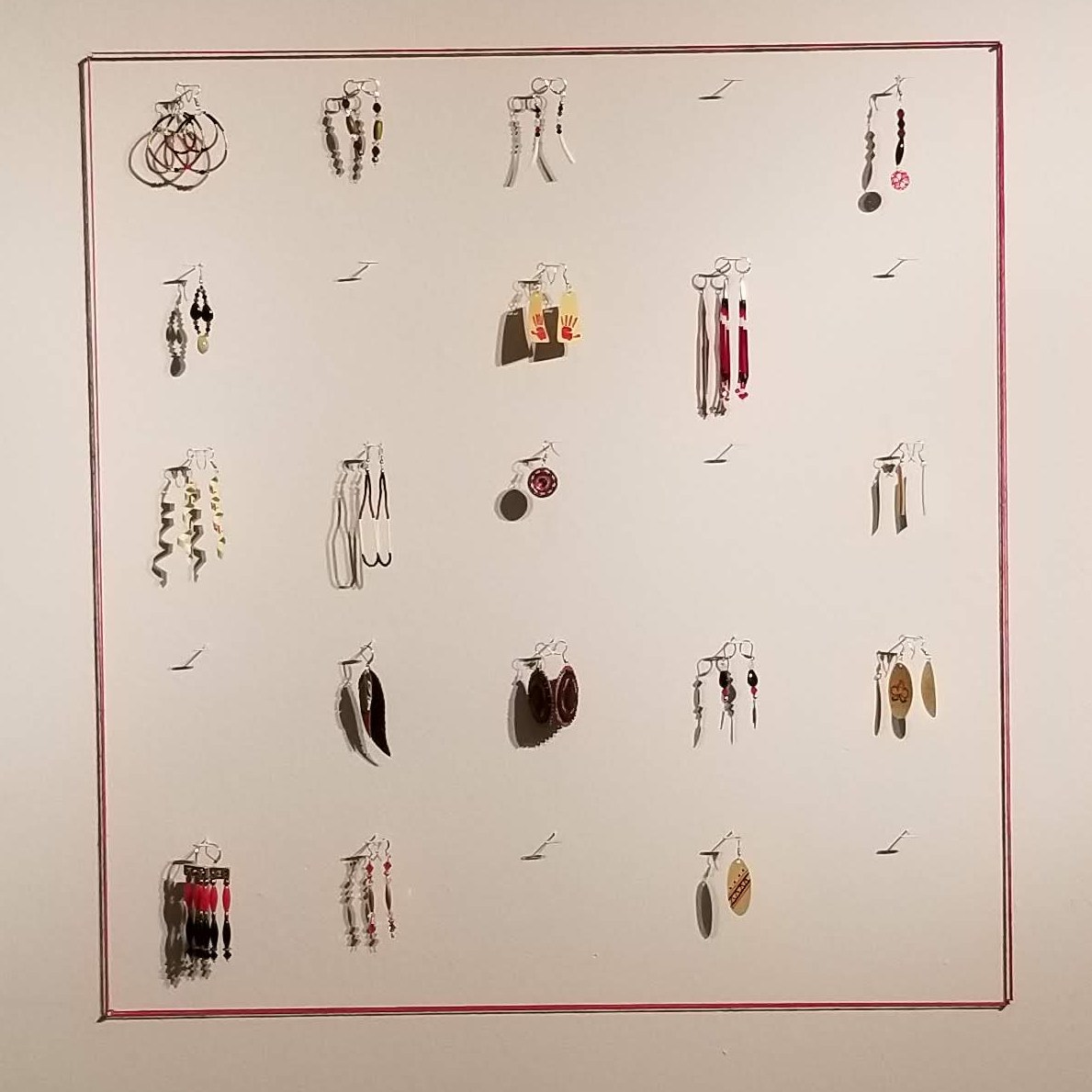
The choices seem to be peeking into the windows of closed galleries, searching #virtualartexhibition, or catching up on my reading. One example that I haven’t been able to share yet (due to the unexpected relocation) is Stolen Sisters, which was on view in February at the Crossman Gallery at the UW-Whitewater here in Wisconsin. Although I wrote about it in the last issue of the New Art Examiner, the topic of the exhibition remains heartbreakingly relevant. Having another opportunity to bring attention to it and the artists included is an easy decision. Checking out their work is especially important now, as with galleries closed and fairs postponed, artists everywhere need support.
Having only digital access to art is difficult. After days of online meetings, the additional screen time is a hard sell for me. But finding connections, or at least looking for them, during pandemic-mandated distancing, turns out to be an essential activity. I am lucky to have art in my home that I look at frequently. Why? Color and texture, connection, memory, meaning. With the computer turned off the paintbrushes and the sketchbooks may lie dormant, but the things on the walls give the space interest. They enliven the experience and raise my spirits during a strange and difficult time.
Last night I heard a performance in an outdoor theater. What I mean is, Iactually heard it. Thanks to the magic of technology my theater experience has been transformed.
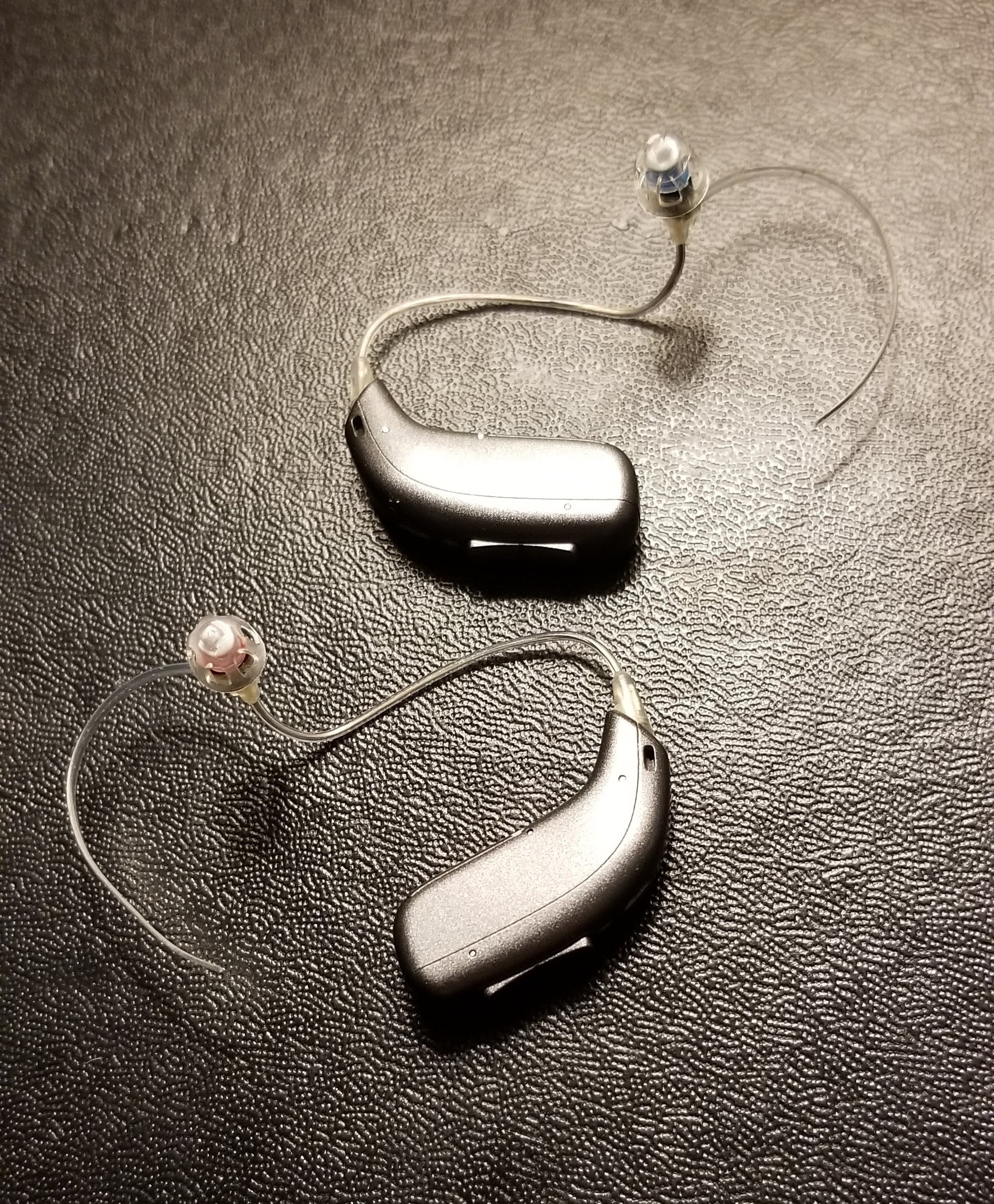
It was only last week that, after a few years of declining hearing and a recent check-in that documented new loss in the mid-range, I finally plunked down the funds and acquired hearing aids. I’ve been told my type of hearing loss is fairly common and that I’m brave for dismissing vanity and using devices. But there is more behind this decision that just being happy to hear again. I’m also hoping to help my long-term brain health. When hearing loss in middle age has been linked to dementia in later life, I’m definitely open to any potential improvement in the aural-processing department.
the newly acquired devices
My hearing (or lack thereof) has been on my mind recently due to a job change. I’ve moved from having my own office–with a door that could be shut–to working in an open plan office. I sit with 3 other people in a group of work spaces around a shared table; four other people sit in a similar arrangement in the same room; three more will join in another “pod” very soon. It is a social group with lots of casual meetings and chatting amidst phone calls, keyboard clacking, and photocopier noise. I knew it would be a difficult transition for someone like me, who prefers a quiet working style. What I did not expect was my inability to participate in conversations that are layered on top of the background noise. It’s not that it’s difficult to hear people, it is just impossible to focus on their words with all of the other noise.
The daily office environment is just one problem I’ve experienced. In the last couple of weeks I have attended three presentations that, despite their similar structures, have provided very different sound environments:
The first: a talk presented by a local art organization. Situated in an echoey room with stone walls and few attendees, in the introduction of the low-voiced speaker, it was also mentioned that no microphone would be provided. I made sure to sit near the front so there would be at least some possibility of hearing something. When the speaker faced the audience–perfect! I could hear everything that was said. When the speaker faced the screen, or when an audience member asked a question? I got maybe 25%. And when people in the audience whispered to each other during the presentation? Nothing. The room was so acoustically bad that I was unable to differentiate sounds.
The second: a training at work, held in a large, high-ceilinged room with multiple tables that each sat 6-8 attendees. Despite having a fantastic tech setup, the presenters decided not to use microphones. Again, when they faced me I could hear everything. If they faced the other side of the room, or the screen, I’d say 25% comprehension was a stretch. When the presenter, finally with mic in hand, asked questions of the attendees but neglected to hand the mic to the person answering? Well, I don’t think anyone heard.
The last: another talk at a local gallery. The presenter used a microphone! The room was right-sized for the audience and acoustically appropriate for the activity! Could I hear? Yes, of course, everyone heard!
The theater experience was a bonus. I had forgotten about it at the initial appointment when tasked with imagining how the hearing-aid adventure was going to work. It was only at the fitting that I thought about my regular ushering commitment. I had one play the coming weekend and two more within a couple of weeks. Having directed many audience members to the venue’s free hearing-assistance devices over the years, I remembered that a recent renovation at the theater included an induction loop system that works with T-coil devices.
I asked my audiologist about it. I was in luck. The hearing aids I selected include an option for T-coil. I was instructed to turn on the T-coil when I got to the theater (press a button, super easy) and see how it worked. Would it work for me? Would it be an improvement on the crackly headphone devices that are available at the theater? Or would I sit through yet another play missing words whenever an actor turns away, or having the device cutout if I shifted in my seat?
I am so grateful for an organization that seriously considers the needs of their fans. Theater has an aging audience, but hearing loss happens throughout life. How incredible to have the plays more accessible to a larger number of the attendees.
For more everyday situations, improvement doesn’t seem so impossible to accomplish. Sure, induction loop systems are great if attendees have the appropriate devices, but scheduling right-sized rooms and using microphones for large meetings are not that difficult. And luckily the hearing aids are already helping with my open office environment (although I still miss my office). Related, although it deserves a dedicated post of its own, #nomorecraptions is providing great info (and a much-needed kick in the ass) about closed captions for online videos.
Basically, if you can’t hear the sound, then you don’t get the fury, and it does indeed, signify nothing. Enable your audience to make sense of your activity. Make use of available technology.
Los Lobos played my local neighborhood festival this past weekend. Listening to the music almost drowned me in nostalgia and sadness, while at the same time smacked me with joy. Let’s just say it was a confusing weekend.
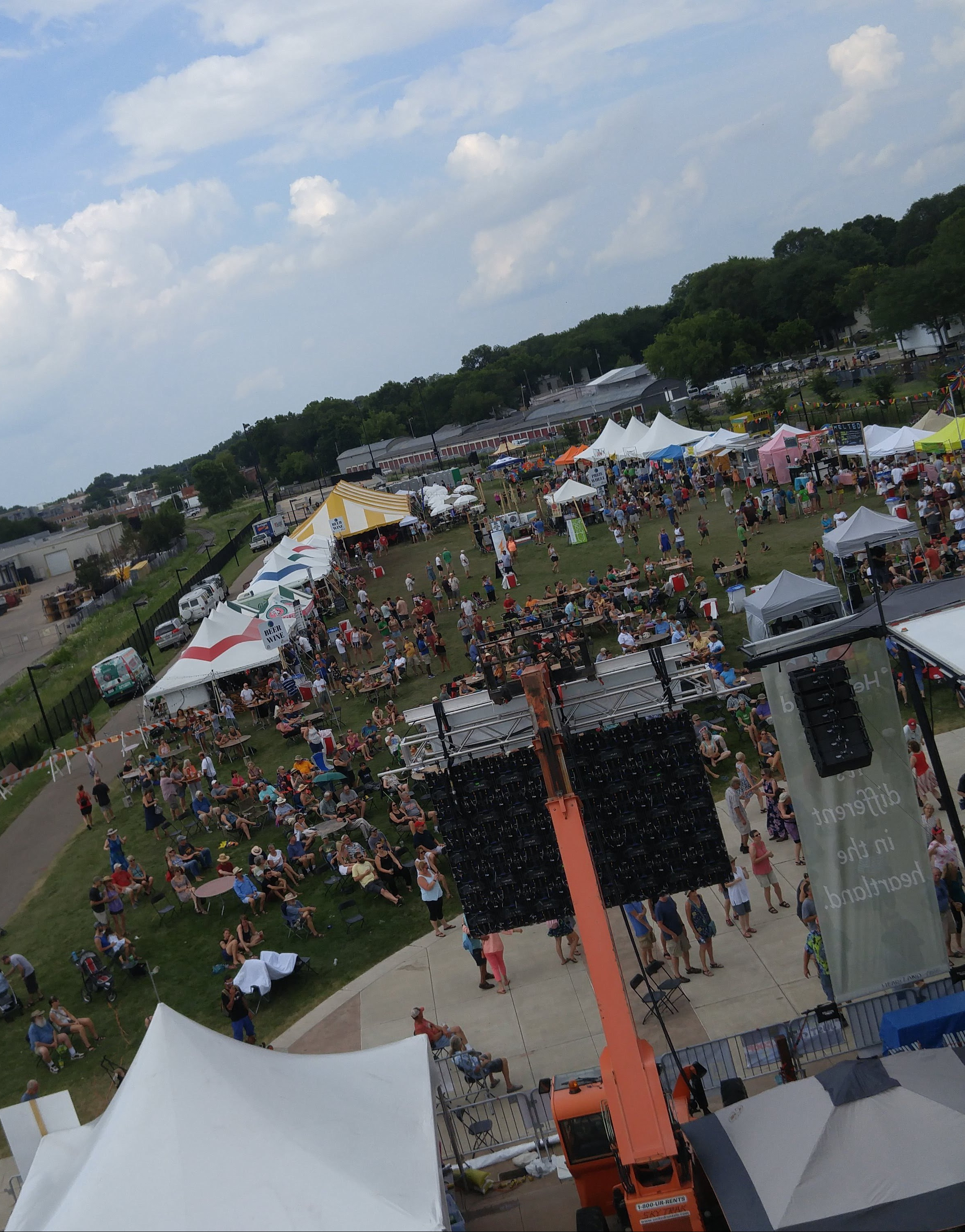
La Fete de Marquette 2018, from the ferris wheel
I help to run the merch booth at La Fete de Marquette, an eastside Madison music festival that just completed its 18th year. Held around the same time as Bastille Day, Fete has focused on music from the French diaspora. France being an old colonial power, this means that—lucky for Madison–the music featured has generally been from many parts of the world: Africa, the Caribbean, France, Louisiana. But this year that francophone emphasis was tossed like a head from a guillotine when the venerable band from East LA gloriously took the main stage on Sunday night.
Despite the white women who, in the close crowd at the front of the stage, bounced and happily flailed their arms to songs like Carabina .30-30, the tall white dudes who cut in front of me and the short couple next to me, filling in the small breathing space we had amid the hot humid air and blocking our view, or the drunk white woman who spilled beer on me while trying to squeeze past then wiped my breast in a failed attempt at drying me (and maybe apologizing?), I had a good time. Really. The music was, well, these guys know what they’re doing. Steve Berlin played with the really compelling opening band, Making Movies, and still withstood the sweltering heat to play the main set. David Hidalgo, Louie, and Cesar delivered their powerhouse sound sans probleme, and the young drummers kept everything moving, even putting on a water show that thrilled the crowd.
The nostalgia for me was overwhelming. I have seen this band in Detroit, when the Bad Livers opened for them in what might have been the strangest billing ever. The crowd was a mixture of bluegrass punk hipsters and extended Latino families, all waiting for hours on a cement floor for a show that started very late but enthralled everyone in attendance. I have also danced to their music at the now defunct Frog Island Festival in a small city park in Ypsilanti, Michigan, in the pouring rain, drenched but dreading the time when the band finally called the show when they felt endangered by the lightning and the water cascading off of the tent around them. The last time I saw them was at the classist disaster that is Ravinia, where I sat behind a wealthy white family and watched the mother text on her oversized iPhone that “these beaners really can rock.” The white season ticket-holders left early, and with all of the rules of the place, none of the many enthusiastic fans on the distant grass were able to take the empty seats or dance nearer to the stage. The show rocked, but also sucked, for the audience as well as (I am certain) for the band.
Being in the crowd at the stage this weekend made me think of Old Town in San Diego, where, so close to la linea, Mexicanidad is made safe for consumption. It’s all chimichangas and paper flowers, margaritas and flounced skirts. It’s the table of gringos who jump up and chase down the mariachis in the middle of their meal, leaving their open wallets on the table and their leather jackets hanging on their chairs. My latinidad is some of these things (I like a nice margarita, I’ve shopped and lunched at Old Town), but it’s also much more. It’s bad spanish, great food, unruly hair, a vague sense of exclusion, but an innate understanding of mestiza; it’s a confusing place.
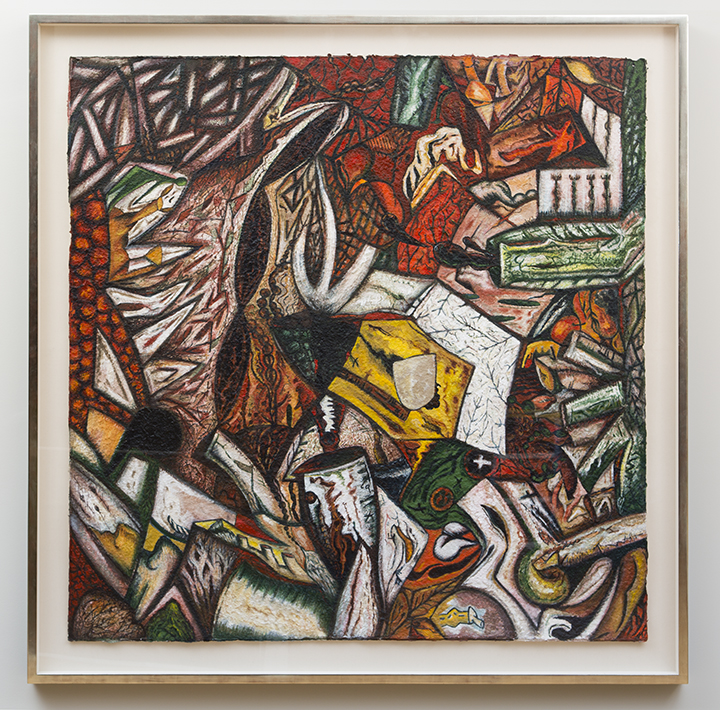
Which shouldn’t bring me to Gronk, but it does. A few weeks ago I worked with a colleague to host a group of Latino middle school students for an hour at the museum. Because there are works by two—two!–Latino artists on view in the entire museum, I chose Gronk’s painting as the focus of our visit. The painting by Gronk that is in the galleries is on Spanish bark paper, which may be similar to the traditional bark papers of Mexico that, you know, held written histories in codex form, but were burned during the conquest, leaving only a handful still in existence. Gronk’s choice of material may make reference to this ancient process, but his imagery captures more recent developments in its vocabulary that riffs off of the murals and graffiti of LA.
GRONK (GLUGIO GRONK NICANDRO) (American, b. 1954) Fragments of a Landscape 1994 Acrylic on Spanish bark paper 78 x 78 in. Chazen Museum of Art, Harry and Margaret P. Glicksman Endowment Fund, Juli Plant Grainger Endowment Fund, and Cyril W. Nave Endowment Fund purchase, 1995.4
My intention was to make a connection between ancient archaeology and Gronk’s notion of “street archaeology,” how, in his wandering around his city, he is looking, seeing, sketching, and incorporating his visual experience into his work. I pretty much failed at achieving my goal of elaborating on this idea of archaeology with middle school students, but I was able to introduce them to a contemporary artist’s work and his observational practice as an example of a latino artist in this world who has been making art every day for a long time (starting with morning coffee; see @elgronk on Instagram for some examples of his visual finds).
Why write about Los Lobos, the Chicano band from East LA, and Gronk, the Chicano painter and conceptual/performance artist? Two experiences of Mexicanidad, both from Los Angeles, each very different. I don’t know LA, and it has taken my entire life to overcome the anti-LA bias that comes with growing up in San Diego. I am also not Chicano—with an Anglo-American father and a Mexican-American mother, we were raised in a white suburb and only visited our Mexican-American family in Arizona on weekends or holidays. I do not know details of these artists’ lives, but I understand there are important differences–gay, straight, extended families, neighborhoods, studio practices, fame, industry biases, communities, histories.
But Los Lobos, their sound and their music, is intertwined with my mid-western experience, and that close relationship makes me think of Gronk’s daily drawing, how this life-long activity of playing music or making art—of developing a practice–enables the creation of a world. Los Lobos, through many years of music-making, have carved out genre-breaking careers that have made them undefinable—rock? Latin? Blues, jazz, jam-band?–and taken them from weddings to neighborhood festivals to the White House and around the world. And Gronk, through his art practice that incorporates drawing, painting, and performance, has made art on street corners, in university museums, galleries, private collections, and on opera stages.
The daily experience of making or listening to music, of making or looking at art—how does it influence our lives? Is it an escape, a luxury, or is it the basic rhythm, the pulse, the bass that moves us forward and provides the structure that underlies everything? I imagine the band members of Los Lobos play music every day, like Gronk and his daily coffee drawings. I am no musician and not much of an artist, but I think about both and interact with both just about every day.
Why do I put up with white women who flail their arms and bounce, blocking my view? Because of the music, man. Because there needs to be more than just two works by Latino artists on view in the galleries. Because those students still don’t see themselves represented in the museum.




 Ann Sinfield: Projects