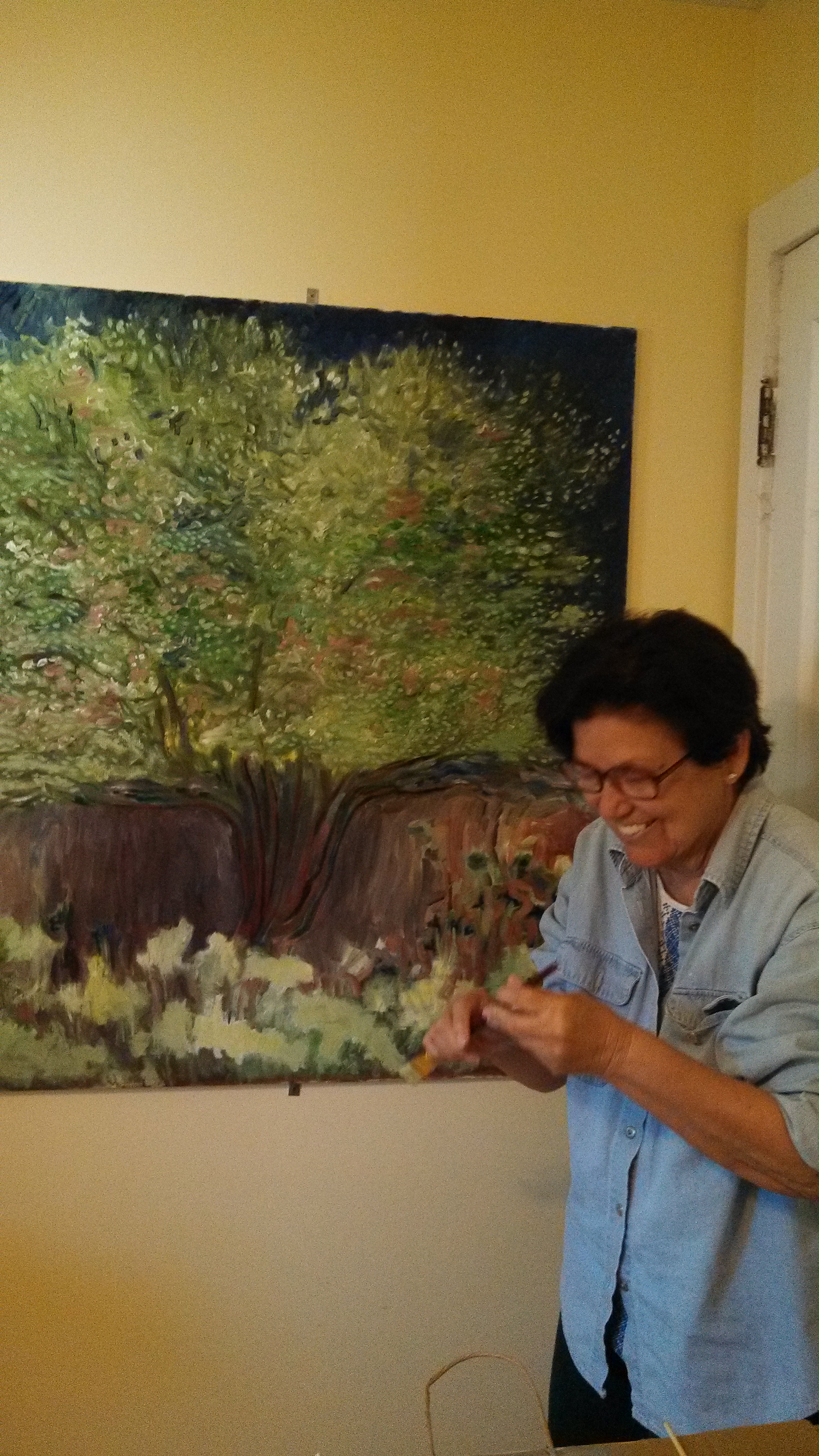
Missing Aggie

Opening the boxes I shipped from my childhood home, I unpack bags of embroidery thread, needlepoint yarn, and canvases – some blank, others hosting loose drawings, and yet others that are partially filled with careful stitches. One of my nieces took sewing projects with pieces of fabric pinned in place, elaborately stitched sections, and yet more material gathered in bags, still uncut. Neither me nor my niece consider ourselves to be textile artists, and we have limited needlework experience. Yet here I am, sorting supplies, finding places for them in my own home, and wishing I had talked about the projects with the one who began them. It would be helpful to know where to start, how to use all of these supplies, and what her thoughts were about the imagery. But it is too late for that. She’s in the ground halfway across this large country, laid to rest beneath mounds of flowers.

My mom gave up a scholarship to art school and chose instead to get married and have a family. Her choice led to unexpected things: travel adventures and international living, a stable home, a comfortable life–all of which must have been amazing for a girl from the desert. 

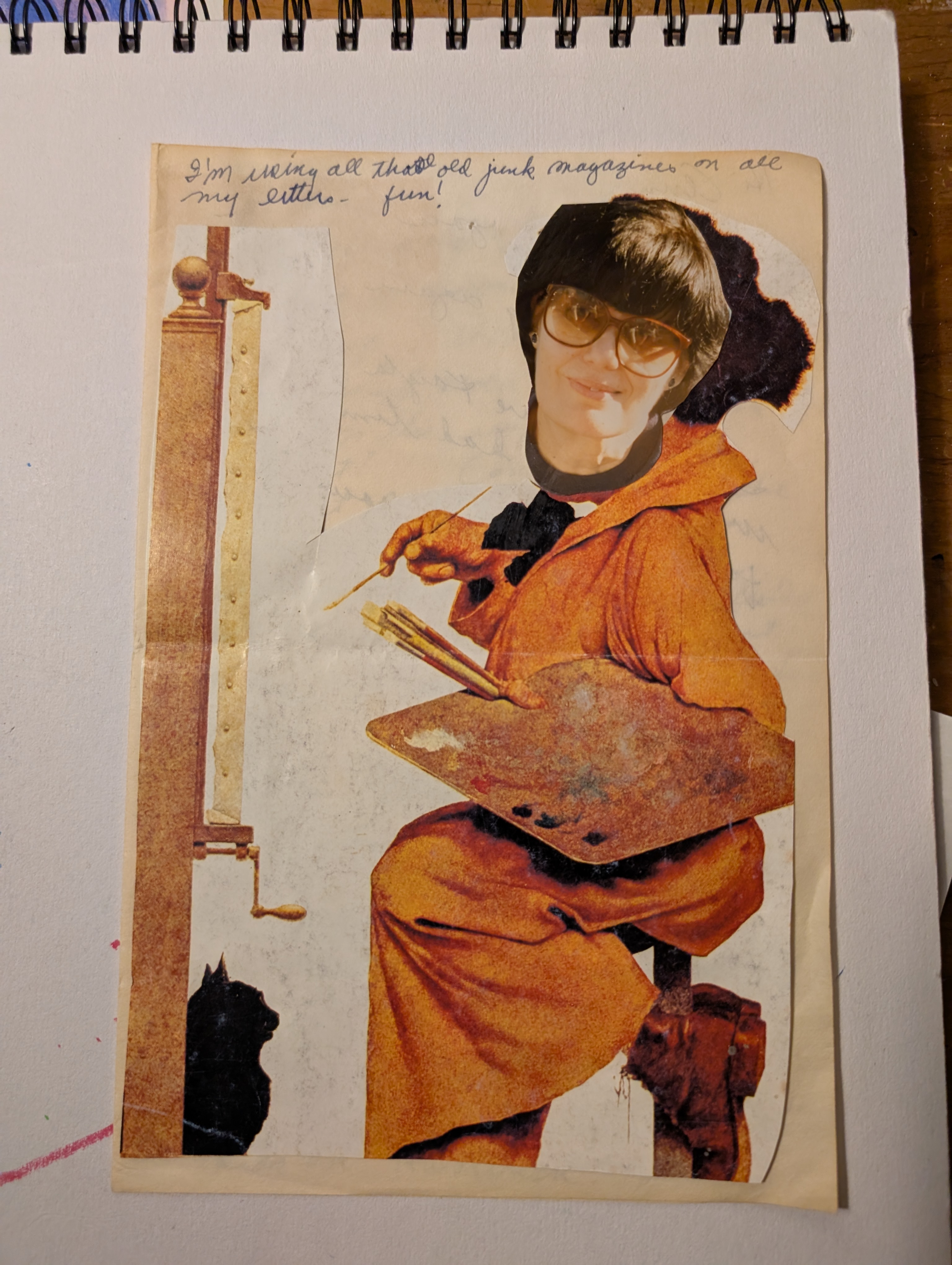
In sorting through the chaos of her things following her years of physical decline, I was able to see her artistic identity resurface. It took shape within the contents of so many boxes and notebooks: recipes clipped from magazines or written on cards (almond cake, apple galette, cheddar cheese biscuits, dark chocolate bundt cake, tequila-soaked watermelon wedges); newspaper articles about museum exhibits, pictures of sun-soaked locales, postcards from family, cards from friends, children and grandchildren; small pictures of colorful things–a Dali painting, lime popsicles, someone else’s tugboat painting, a photo of mountains in Nepal. Some pages list strange-sounding medications, with dates and check marks of what was taken and when: Eloquis, Bistolic, Metformin. Other pages have random sentences, written multiple times, almost like mantras, “Tian Taru Studio in the village of Alas Sidem on the island of Bali, the tree that grows between heaven and earth.” Some people call these scrapbooks, but I call them my mom’s sketchbooks. They are collages of her loves, her desires, and her changing reality.

When she was healthy she was prolific, working in so many media, loving beautiful things. Art permeated her life. When I was a kid she cast plaster birds in sand in the backyard and made me sit still for hours while she painted portraits. She made pieced and sewn fabric wall hangings, created embroidery and embellished needlepoints. She also sewed many quilts, including a Starry Night quilt for my 40th birthday that I sleep under during the winter (it’s got polar fleece inside so is definitely a seasonal choice). Her paintings–oil on canvas or paper–populate her family’s homes. She never really completed paintings, we just had to take them when they were available, before they were painted over into something completely different. During one of her visits, I set her up in my kitchen with a stretched canvas on the wall. Over the week she stayed with me I watched the imagery change: first a tree, then me beneath it, the next day I was facing the other way, then finally I was gone and only the tree remained. I’m in there somewhere, beneath layers of paint, forever working in the dirt beneath the blooming lilac tree that still stands in the backyard.

Seeing a recent fiber art exhibition made me think again of my mom. Her practice was a solo one, she worked by herself in her home. She had no artistic community beyond her family, and she showed her work only rarely in her lifetime. But I know she would have enjoyed this show and appreciated the efforts of women who have worked together and supported each other for so many years. She would have loved the work. 

It’s a gift I received from her, this love of visual art. It’s a language we understood together. My mom knew so much about art from thinking about it, making it, and from just looking at the world. She was a smart, observant, creative force, who loved us. That’s a powerful thing to carry forward.

When I miss her, I know now that all I need to do is go look at some art work. And there she’ll be, right there with me.

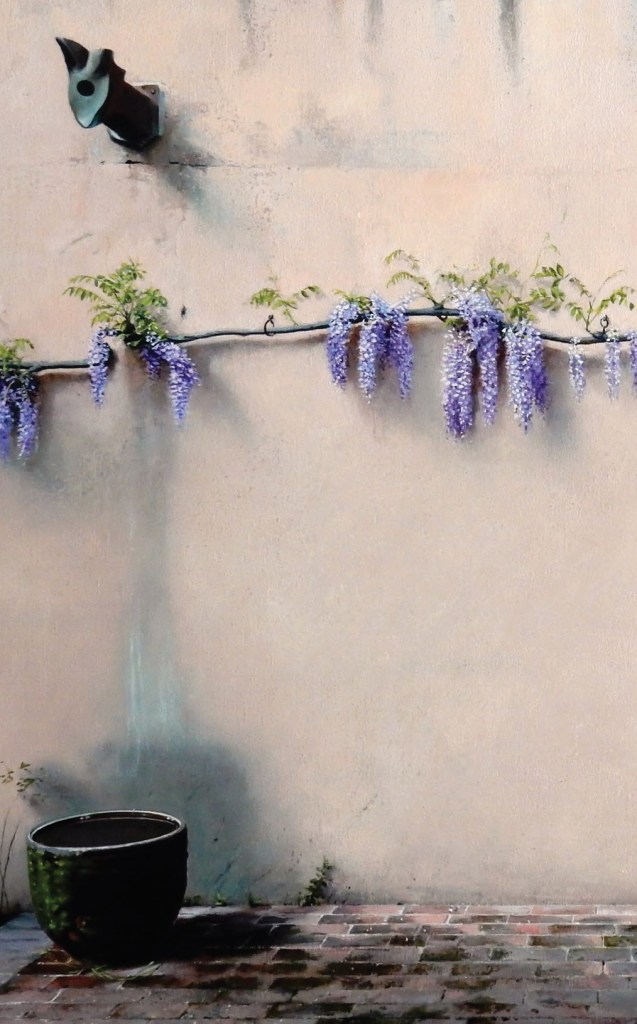
Details!

Waiting Rooms and Other Imaginary Places

Within the limits required by the global pandemic, I am hoping to someday regain my ability to focus and move onto some research and creative work. Until that happens, or until I can get out and see something new, I am lucky to have time to look back at some pre-isolation projects. 

In 2019, in the midst of relocating to a new city, I had an opportunity to write for the artist Carol Pylant when an exhibition of her paintings opened at the Gallery Victor Armendariz in Chicago. The artist published a catalogue to accompany the show, it included essays by me and Buzz Spector. I can’t convey how powerful it was to walk out on the last day of my job of 14 years, drive to Chicago, and attend the opening of an exhibition where I was a catalogue contributor. At the event that night I was repeatedly asked a completely mundane social question, “where do you work?” The answer was surprising and gleeful: Nowhere! (which was also truthful, as I wouldn’t start my new job until the following week). Now, a little over one year later, in a world that has changed in so many unexpected ways, the essay from that catalogue has taken on new meaning. 

Although I can’t share the entire, beautiful publication online–contact the artist or the gallery to get your copy–it is a good time to share Pylant’s work again. The stillness and spaces that she represents are relevant metaphors for the current condition of the planet. We are in a global waiting period of worry, care, and loss. In this pandemic-necessitated pause where we attempt to protect ourselves, care for each other, isolate for wellness, and bury our dead, our world is transforming. The paths forward are unknown. Where will we start again after the world shuts down?

Here is my essay from the 2019 publication.

Waiting Rooms and Other Imaginary Places, in Carol Pylant: Portal Paintings 2009 – 2019

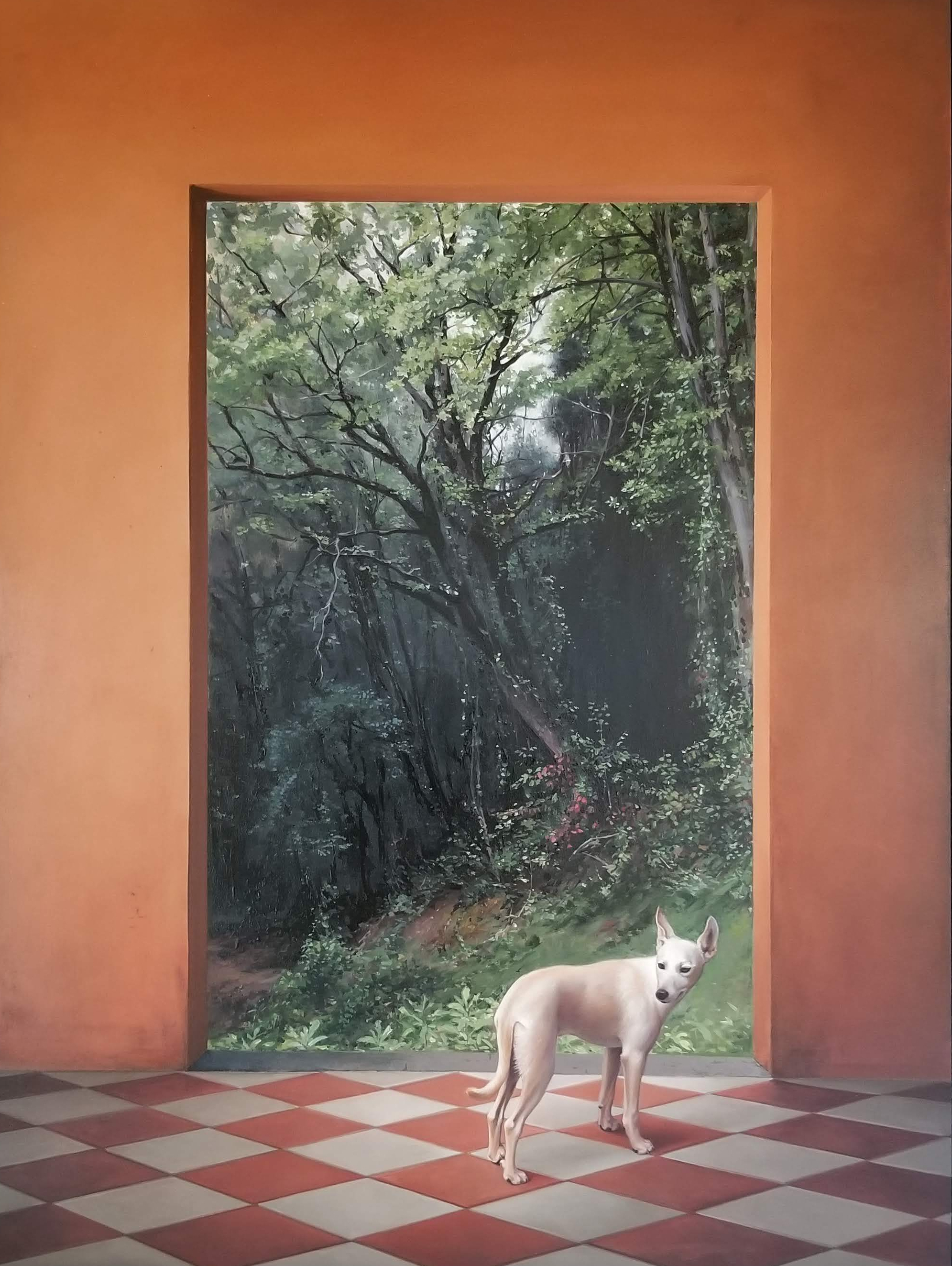
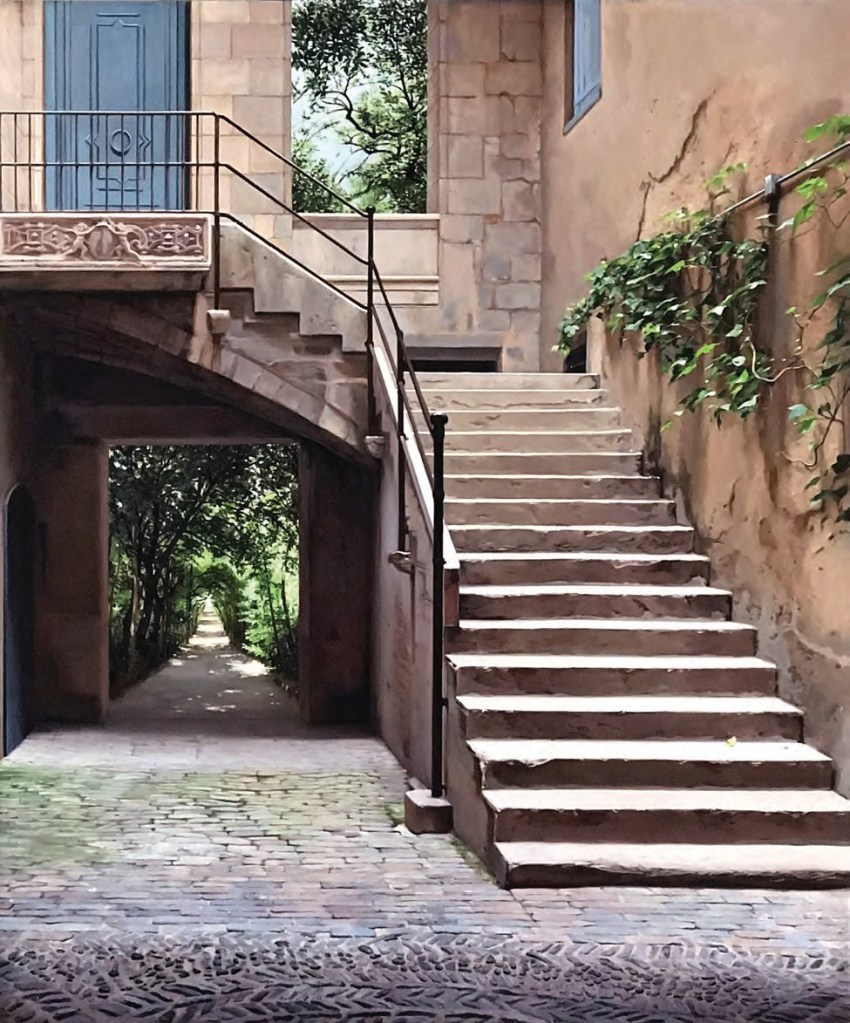
The paintings in Carol Pylant’s Portals series present quiet and formal spaces inhabited only sometimes by dogs or peacocks, statuary, or figures carved in relief. The titular portals are doorways and windows that open onto landscapes, some wooded, others lake views, some frozen, some misted, and yet others on fire. These places are gorgeously, meticulously rendered—once the artist’s process is understood they could also be appropriately described as painstakingly detailed. In this detail they are mesmerizing, but the illusion of reality that is presented is disorienting. Pylant is a tremendously skilled painter. The power of the works lies not only in their careful style, it is also in the construction of unnerving scenes that operate via a disjunction: although the pictured places are not real and the settings are simply not possible, there is a connection to a reality of some sort, as the works are based on actual places. This disconnect between the real and the imaginary is magical.

The works can be understood as stage-like. The settings show signs of age but are within indeterminate, and thus suspended, time. Certainly there is a potential for action in the emptiness of the architectural spaces, but also in the invitation offered by open windows and doorways, paths leading off into woods or views of lakes with far shores. The opportunity for exploration of the space beyond is potent, as the represented landscapes are not clean and ordered like the foreground spaces, but instead are undefined, unmarked, unidentifiable by landmarks or other distinguishing features. Some of the landscapes have clear paths presented, others have no clear entry discernible, but all provide a marked contrast to the symmetry, quiet, and weight of the architectural spaces.

Carol Pylant, The Path

What is represented is not the simplistic dichotomy of outside/inside or nature/culture. These architectural spaces are places that Pylant has seen or visited or lived. The same is true with the landscapes: North Carolina, Ireland, Spain, Italy, and Wisconsin. The personal experience is here made real, not simply the act of visiting and remembering these places, but in connecting them, overlapping them, collaging them together to form something new, something different than a memory. As a mash up of former residences and travels, the paintings become a visualization of the act of remembering, of mental life. More than just locations, they are a map of experiences, lived and seen. What breaks the dichotomy and launches the works beyond a simple matchup of disconnected architecture and landscape is the sense of waiting, of impending action or unspoken words that permeate the represented spaces. Not a nostalgia for lost places, but rather the potential for narrative and its related act of sense-making is what is conveyed by the works: what and how we remember, how we make connections, the stories we create as our minds leap between seemingly disparate elements, places, and things; how the very activity of accounting or chronicling makes memory and shapes it into useful bits.

Carol Pylant, Eternal Spring

These are not simply pictures from the artist’s memory, postcards or souvenirs of world travel. Rather, the paintings are sites where memory and place are put to work and utilized for altogether different purposes. Where are these places? In Pylant’s memory they are tied to distinct experiences. But what do they mean, how can they function, for anyone other than the artist? When represented so distinctly, when combined unexpectedly, these disparate locations lose their individual identities and become resting places, temporary holds, places where time is suspended, where stories can be formulated. They are transitional spaces, the boundary between the formal and the unkempt, the ordered and the wild, the confined and the free. They are specific enough for a viewer to imaginatively inhabit, but have just enough disruption to generate unease and thus a desire to get moving.

What is intriguing about the work is why an artist would be interested in representing liminal spaces. In the choice of not telling a specific story, but creating instead spaces where narrative can be formulated, Pylant reveals something about herself. As a teacher she created very real spaces for her students to develop their own storytelling techniques; perhaps these settings were created to make space for her own personal acts of remembering and understanding. In the disconnect between the aging archways, carved figures, checkerboard floors and quiet dogs, the dense woods or open bays and distant hills, Pylant uncovers the opportunity to engage quietly, the option for thoughtfulness, and calm consideration. She represents pause, which is here exposed as an inhabitable place, attractive, and rich with potential.

Carol Pylant, Artigas Spring (detail)