
Details!
This evening the artist will be interviewed by another curator. More words to weave through and around the work and her practice, more meaning to dig into, more to uncover and understand.
But will they talk of beauty? That’s what drew me to her work in the first place, the drop-dead gorgeousness of it all. Surface and material, color and texture, the space it demands. That’s what I need to convey: how artwork can carry complex and intellectual meaning but also be beautiful.
This all started at the Alice Wilds exhibition, “Wrapping Air In Cloth and Other Seemingly Impossible Tasks: Nirmal Raja,” on display in Milwaukee during November and December of 2019.
I was lucky to attend a gallery talk by the artist and was struck by how connected I felt to the work. Raja’s use of visual language is powerful. She is able to take feelings of dislocation and loss, global experiences of violence and vulnerability, or personal practice, and transform them into visual experiences that are not only comprehensible, but also incredibly beautiful.
It is a difficult balance to achieve, I think, this equilibrium between content and aesthetics. I’m not even sure these are the best terms to describe what I’m trying to say. The meaning that many artists strive to convey can be masked or obscured by the visual experience. For works to convey meaning, it can be helpful to invite the viewer in somehow, to make them feel–if not welcome, then at least interested. Beautiful work may not always be complex, but it can whack you over the head. That’s what I am interested in. Raja’s work smacks hard. Double-whammy.
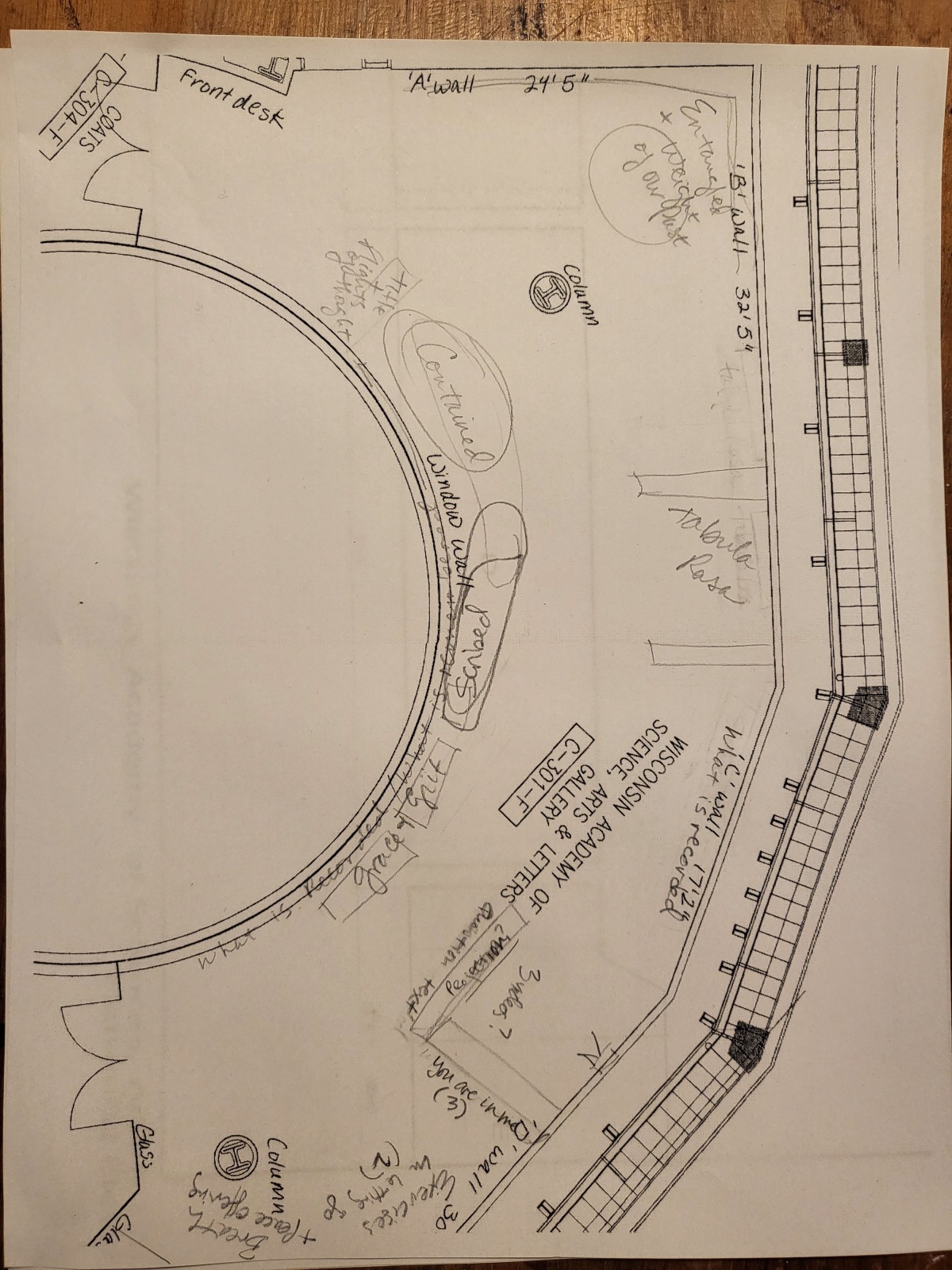
So that’s what I’m working on now. Trying to find the words, finalize the checklist, and develop the gallery layout for a group of works that will convey some powerful meaning in glorious ways. The exhibition opens in Madison at the end of August 2024.
Struggling to find my voice as the country disintegrates. Not confident that I should write at all, as words seem futile in the midst of state-sanctioned violence. The attacks–both the direct brutality of uniformed thugs and the indirect aggression of massive leadership failure–leave me scared and angry. But what about the activity that I always turn to, what about the act of looking, what about artistic practice? Where does art making fit into this crumbling world?
I have written about Nirmal Raja’s work previously, and now she is working on another really interesting project she calls Feeble Barriers. The work is intimate and ambitious, beautiful and wrenching. The creation of these new delicate objects has unfolded on Instagram and the entire body of work created so far is on view at the Grove Gallery during July 2020.
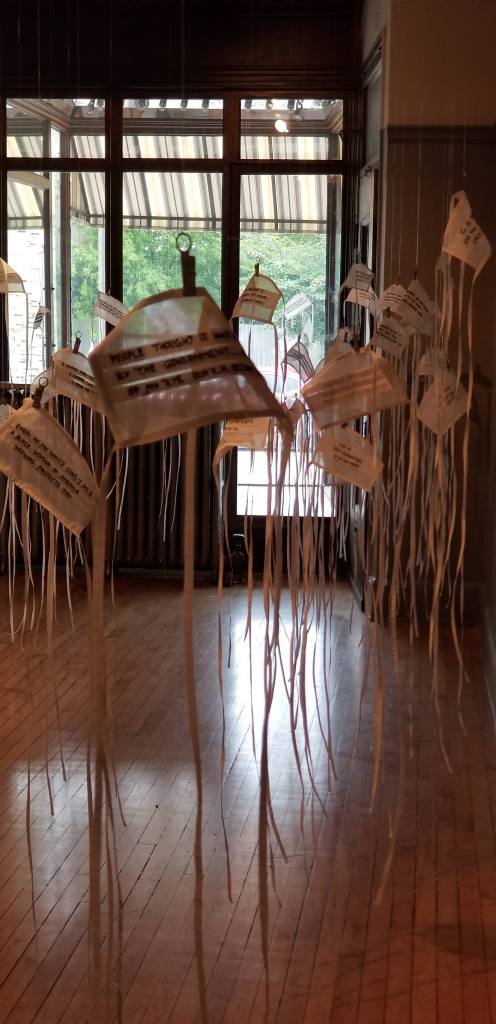
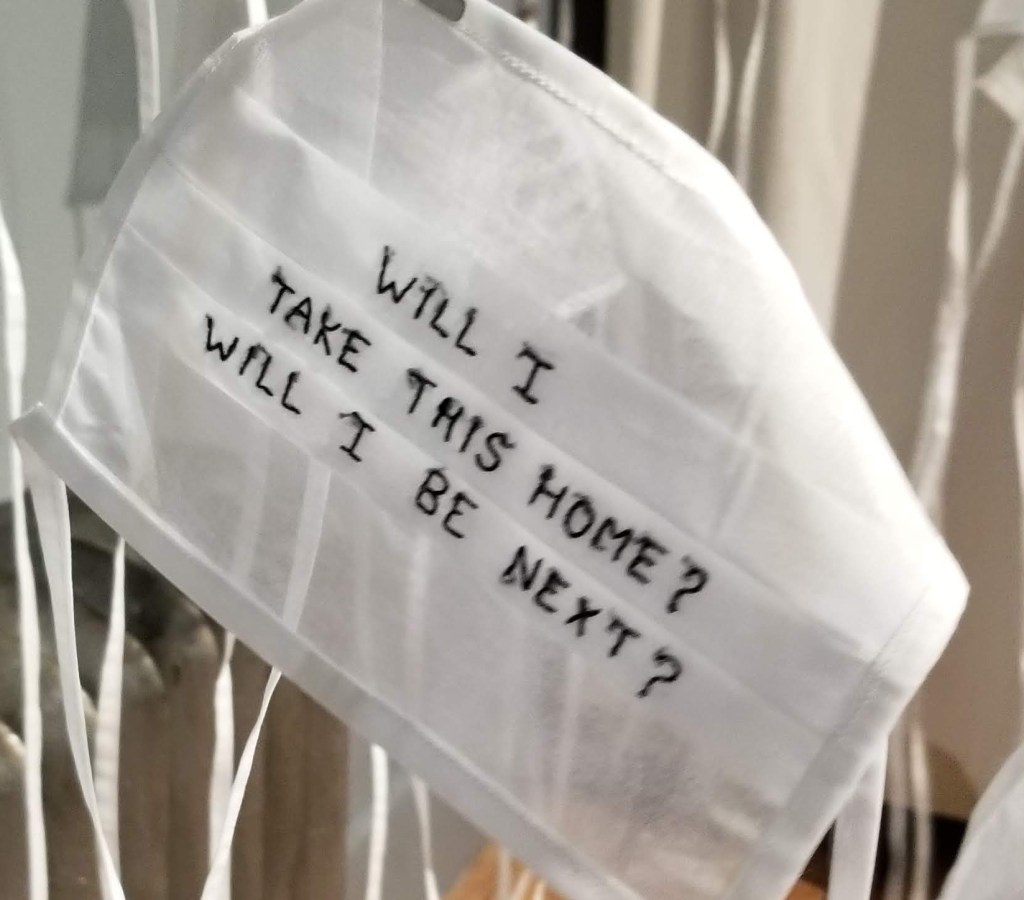
The artist has posted a short video about the current installation, and she was interviewed about the work by the UW Center for Design and Material Culture. The project is on-going, as Raja continues to gather thoughts from medical professionals across the globe who are working in pandemic response. As a daily practice, the artist stitches their words onto delicate face masks constructed of sheer cotton organdy. The individual pieces are ghosts of personal protective equipment, their fragile structure bearing the worry that pours from mouths that are hopefully shielded by more functional barriers.


The resulting work is thoughtful and terrifying. So far, 75 masks have been made. There is desperation in the words from these frontline workers: they speak of racial inequalities, personal fears, and societal dangers. These are individuals who are committed to saving our lives, here they describe the personal, tragic impact of the pandemic.
The fragility of these masks suggests a profound contradiction: the very idea that protecting life takes only a piece of fabric. It is a humbling thing. So easy an action–wearing a mask–makes its refusal confounding. A small thing to ask, the fabric placed between you and me. There are people selling useless masks on Etsy–crocheted items that in their creation mock the deaths and losses the world is enduring. Such action raises the specter of what exactly is it that is feeble here? The sheer cotton organdy, the fragility of over-stressed medical frontlines, the actual PPE, or the fact that any controversy exists at all about the use of masks to prevent the spread of an airborne virus?
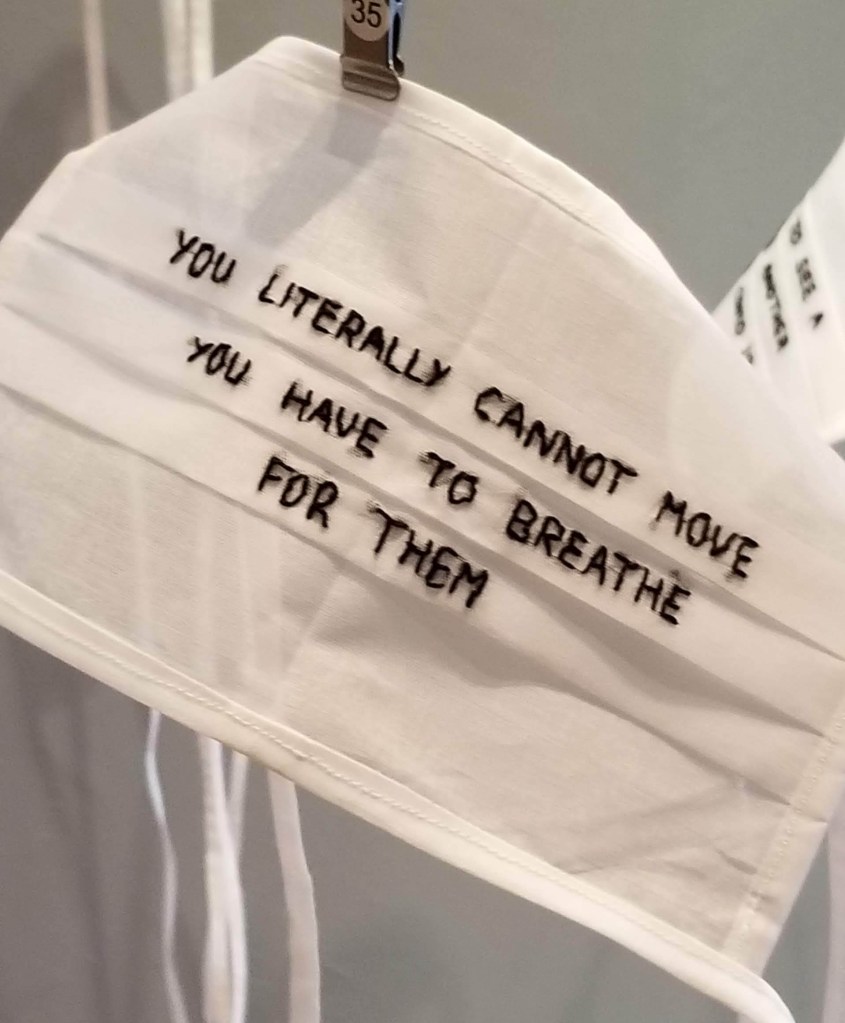
Raja’s use of delicate handwork to represent healthcare workers’ personal experiences is powerful, yet it is frustrating in its existence. It is devastating that we need work like this. But in her choice of a close and time-consuming method like hand-stitching, this artist honors the dedication of the medical professionals who are trying every day to save our lives. This project demands attention to their (and our) plight.
Another exhibit, at The Warehouse in Milwaukee, presents a different kind of connection during this period of isolation. On display into October, I Am A Story: Self-Portraits provides an opportunity to see a variety of faces, an activity that I found surprisingly refreshing after weeks of mostly online interactions.
Many artists are included. Carol Pylant’s representation of the intense stare of a tension-ridden younger self, and Richard Diebenkorn’s drypoint face made from lines that divide the plate into discrete areas like those in his landscape paintings, provide contemplative relief. Della Wells is represented with a painted and collaged side-glance self-portrait commissioned for the exhibit. Pat Steir inserts herself into art history as Caravaggio’s Medusa and Rembrandt in a Cap, and Ann Hamilton presents herself as gorgeously obscured.
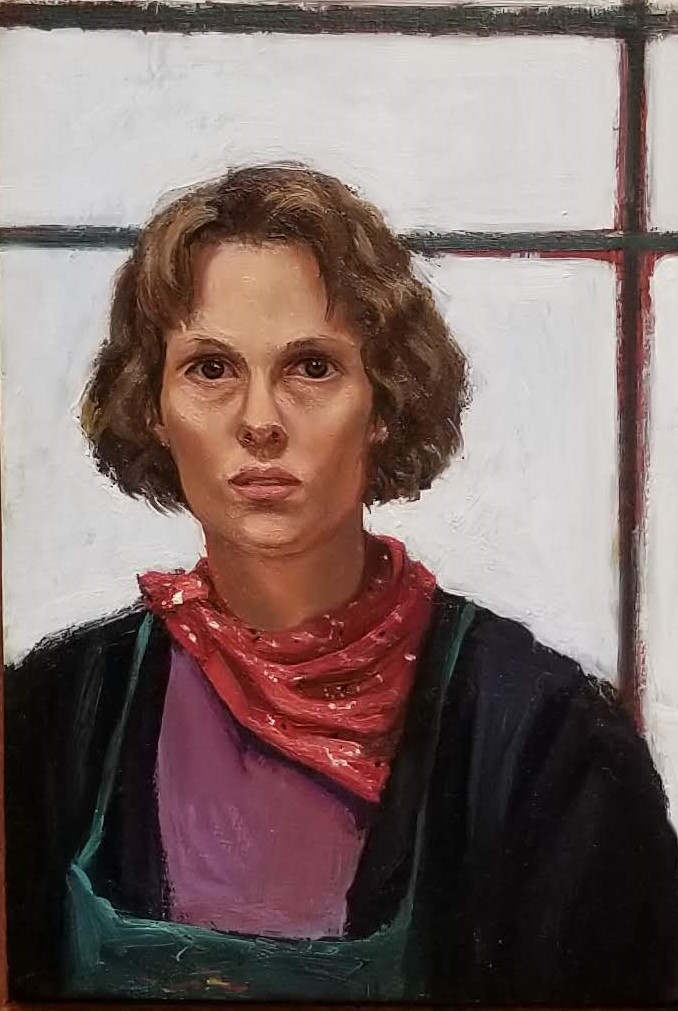
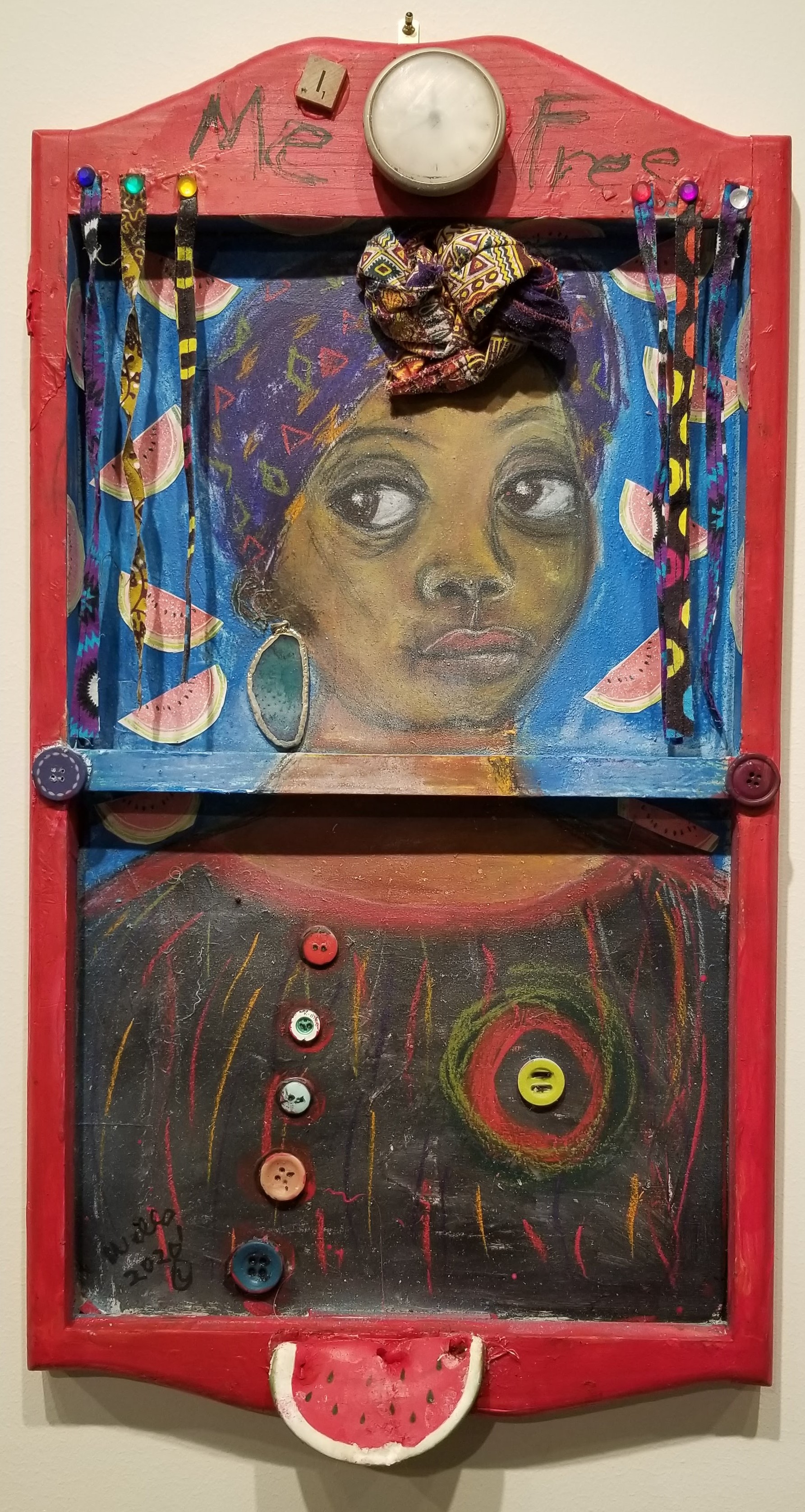
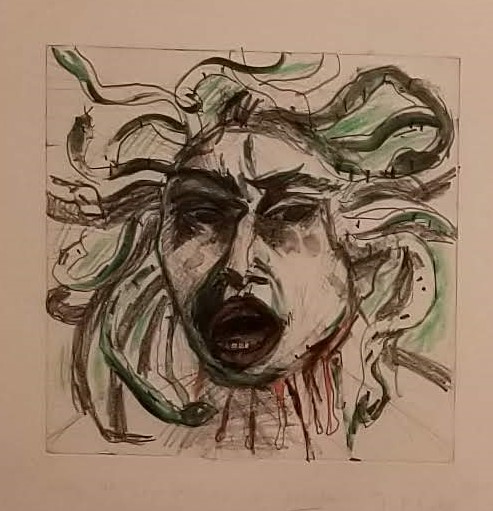
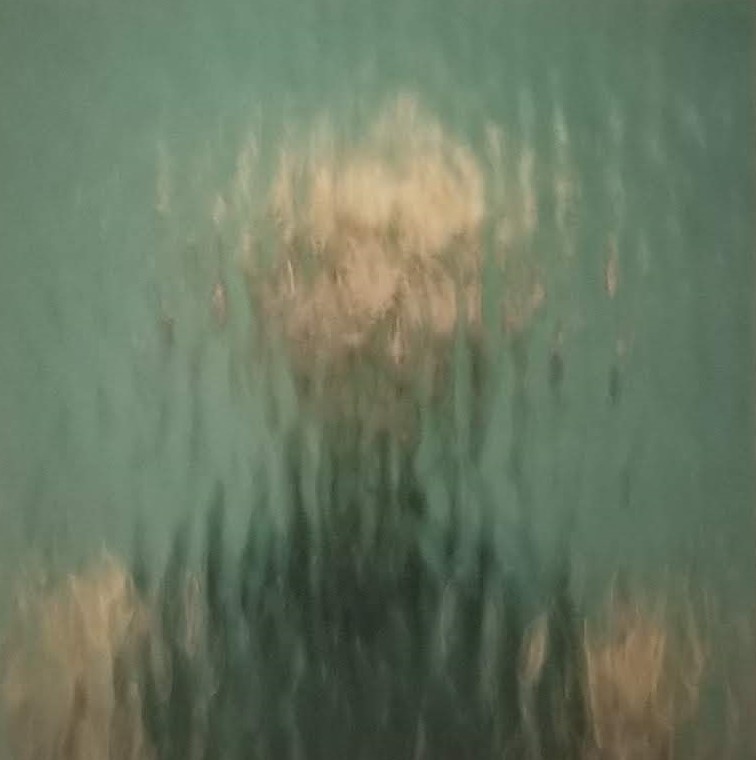
This is a really nice show to visit, although with very little interpretation available the experience is limited to looking and responding rather than learning anything about these artists and their representational choices. But that’s exactly what I needed right now, a chance to see some new faces and think about something other than my four walls and the crumbling world.
Restorative, communicative, hopeful. The physical experience of looking allows access to other people–through their handmade objects or their representations of self–at a time when distance is required for personal safety. Human connection is worth pursuing right now, and saving. Despite the terror, the anger, and the fear, we have to keep trying. It may be a struggle to get through every day, but acknowledging what we have and reminding ourselves what we fight for, continues to be a vital effort.
 Ann Sinfield: Projects