This evening the artist will be interviewed by another curator. More words to weave through and around the work and her practice, more meaning to dig into, more to uncover and understand.
But will they talk of beauty? That’s what drew me to her work in the first place, the drop-dead gorgeousness of it all. Surface and material, color and texture, the space it demands. That’s what I need to convey: how artwork can carry complex and intellectual meaning but also be beautiful.
I was lucky to attend a gallery talk by the artist and was struck by how connected I felt to the work. Raja’s use of visual language is powerful. She is able to take feelings of dislocation and loss, global experiences of violence and vulnerability, or personal practice, and transform them into visual experiences that are not only comprehensible, but also incredibly beautiful.
It is a difficult balance to achieve, I think, this equilibrium between content and aesthetics. I’m not even sure these are the best terms to describe what I’m trying to say. The meaning that many artists strive to convey can be masked or obscured by the visual experience. For works to convey meaning, it can be helpful to invite the viewer in somehow, to make them feel–if not welcome, then at least interested. Beautiful work may not always be complex, but it can whack you over the head. That’s what I am interested in. Raja’s work smacks hard. Double-whammy.
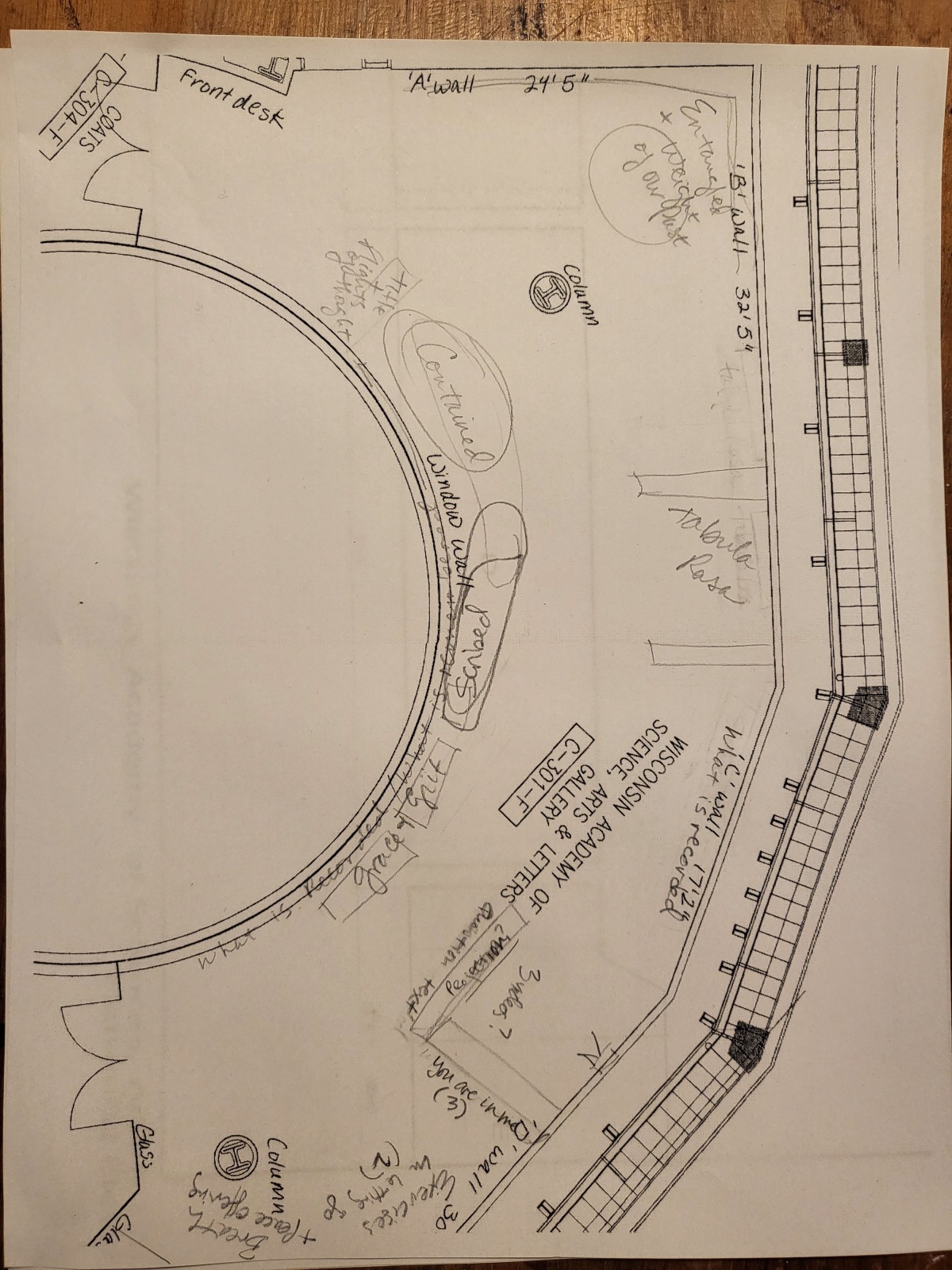
So that’s what I’m working on now. Trying to find the words, finalize the checklist, and develop the gallery layout for a group of works that will convey some powerful meaning in glorious ways. The exhibition opens in Madison at the end of August 2024.
“I remove such stuff as could make visible the remainder as armature of a different value.”
Buzz Spector
Not objects as an end, but objects as jumping off points. It is the spark that is interesting, and the process, not necessarily the conclusion. Because the objects don’t really end, they just stop and offer up a waiting area for what’s next. Like a train platform, or a cliff ready for a hang-glider.
A man in the otherwise empty, serenely quiet gallery interrupted my looking, my thinking. He asked me, “Do you think the art is about the content of the books? Do you think the artist is interested in what the books are about?” Maybe this man has my usual approach in museums and doesn’t read labels. I told him to read the labels.
(OK, that’s not all I said to him. I was balancing the frustration of being interrupted by a man as I looked and thought. Did I appear to be doing nothing? As a woman, did I seem to be waiting for a man? Someone to ask me to help him out of his confusion? But then I realized this is something I’m actually good at, something I happen to enjoy: talking with people about art in galleries. And although my thoughts were nowhere near shaped yet, I stepped out of my head and entered into a conversation).
“Buzz Spector: Reading Matter,” installation view
At that stage of still standing on the shore, of not having really waded into the work yet, I gave this man some guideposts. I said yes, I think the artist knows what is in the books. And not only that, but I think he loves books. A lot of his work deals with books or their composite parts: paper, binding, words, communication. And I did suggest the man read the labels, because they are really helpful in providing, you know, context.
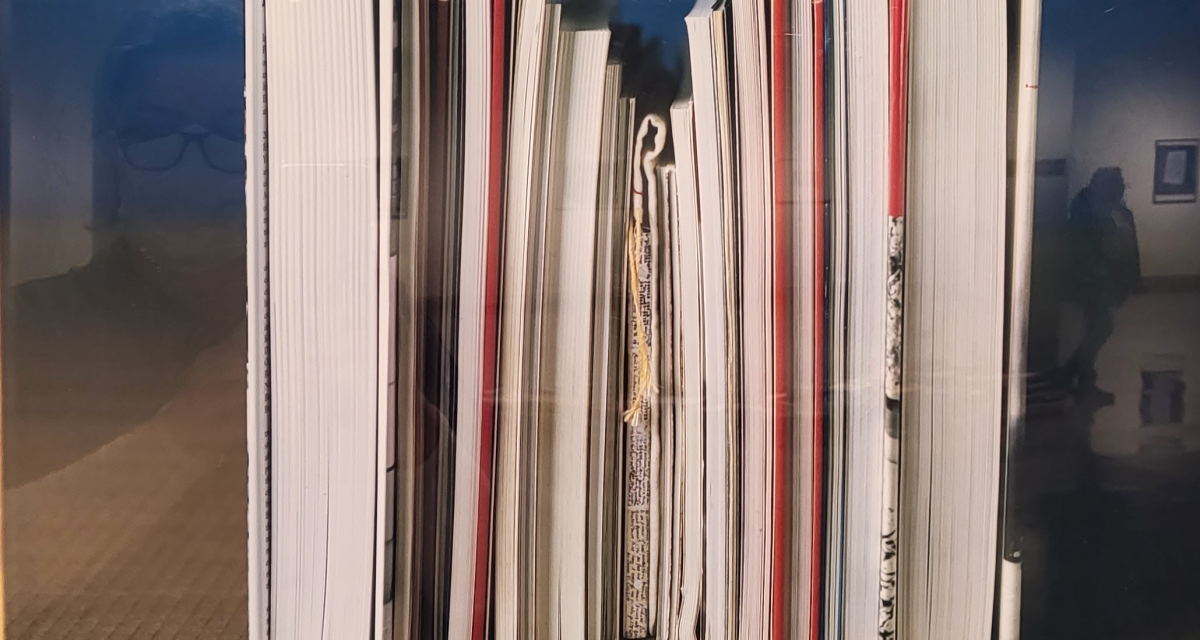
Books and their context: paper, words, photos of books, frozen books, books as building blocks, books deconstructed or altered (and pencils, but that’s a different post). And what books? Well, you can’t know just by looking, for most of them anyway. They are pictured with titled spines turned away, their pages are missing, or they are actually invisible, buried and unknowable within multiple stacks.
This is where the labels help in showing the bigger picture, explaining how the books and paper are not alone, they do not exist here as isolated objects. They are each physical (or pictured) items within extensive, interconnecting webs, which the labels themselves are part of.
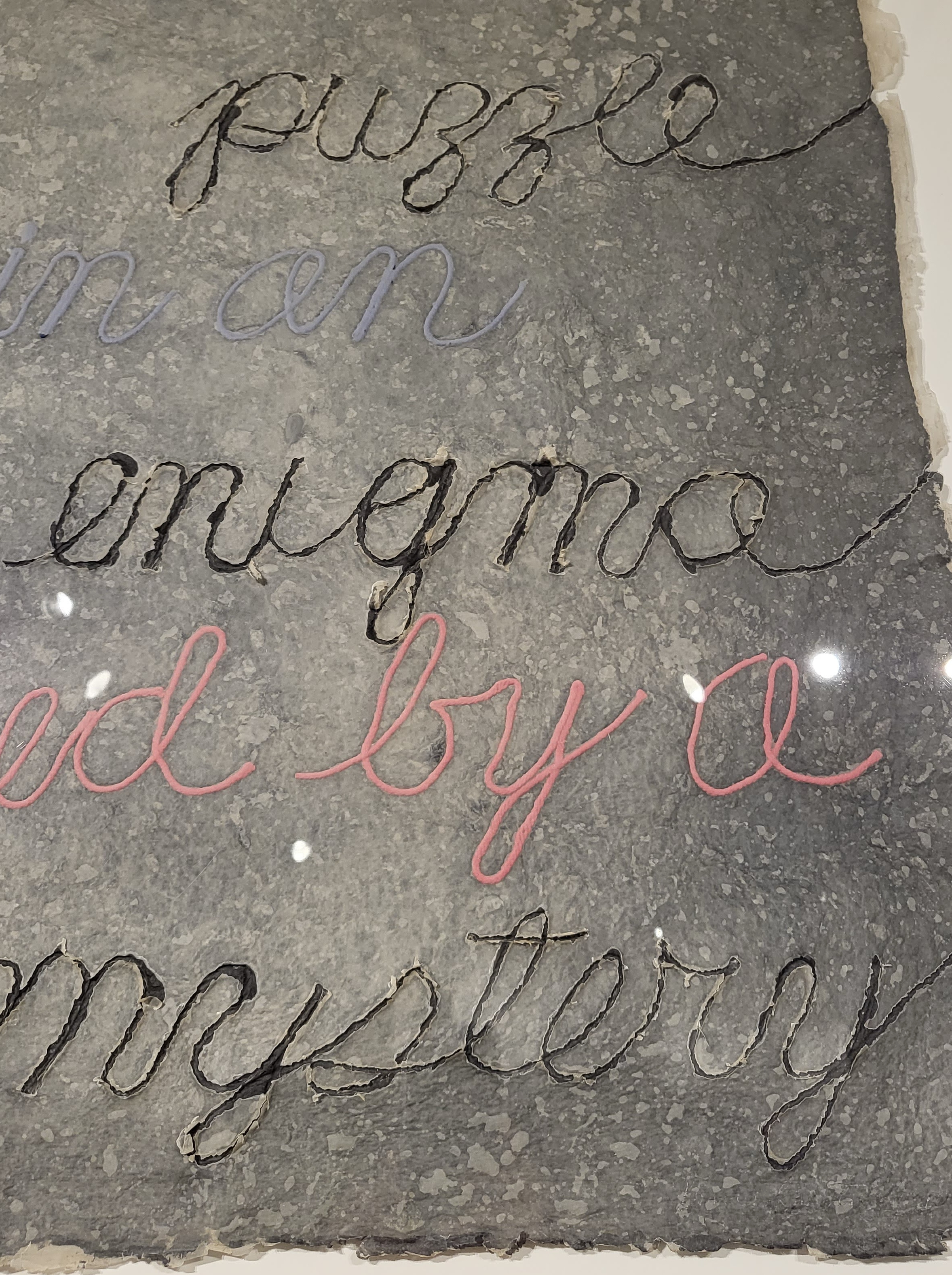
The labels explain that an individual book, pictured or altered, can be part of a collection or refer to another artist’s work. Torn paper is just one element in an on-going conversation, across time and distance, and even academic discipline. The title might be funny or sly to those in the know. But for all of us who are not academics, or not-so-well-read-in-the-classics? A book whose pages have been carefully torn and reduced to beautifully feathery but illegible shapes becomes a decision point: is the vagueness of meaning acceptable enough (am I contented), or am I intrigued enough to put in some effort and find out who the fuck Actaeon is? The missing parts expose the curiosity of the viewer, who becomes part of the context. No longer just looking, they’re involved now, with thinking, with seeing; they are connected and the web is extended even further.
The content of the books is very important to Spector, but it’s not the primary focus of his work. He doesn’t, for example, make images that refer directly to the stories or arguments presented in the books. Instead, he removes the text, rendering the book unreadable. In tearing away the content, the structure of the book is revealed, exposing its utter strangeness. The loss of the text is shocking, but it is a void that brings the function of the book into the spotlight. If it can’t be read, what is this paper thing that usually communicates ideas across time and space?
Words connect people, and books for Spector are (maybe) just one form of something that holds words. Without their words, books are no longer disguised by a purported use and can be seen more generally for what they are: containers. It is not the words themselves that are important, but rather the ideas and connections that are carried and supported by those texts. Once consumed, the words become thoughts that can be shared and changed and expanded. And once pages are torn away, books are freed to become something else: beyond narrative or explicative repositories they are now unknown objects, mysteries for strangers to ponder, together or alone, in a quiet gallery.
The altered books challenge us to connect and question, to learn, or decide not to. Together we not only replace what is missing, but we expand upon the loss by exploring the books beyond their physical forms. From the muted, missing books we leap, get lost, maybe find help, and (stacking things, tearing things up), we connect and create.
“Buzz Spector: Reading Matter,” is on view at the Rockford Art Museum from February 4–May 29, 2022.
Within the limits required by the global pandemic, I am hoping to someday regain my ability to focus and move onto some research and creative work. Until that happens, or until I can get out and see something new, I am lucky to have time to look back at some pre-isolation projects.
In 2019, in the midst of relocating to a new city, I had an opportunity to write for the artist Carol Pylant when an exhibition of her paintings opened at the Gallery Victor Armendariz in Chicago. The artist published a catalogue to accompany the show, it included essays by me and Buzz Spector. I can’t convey how powerful it was to walk out on the last day of my job of 14 years, drive to Chicago, and attend the opening of an exhibition where I was a catalogue contributor. At the event that night I was repeatedly asked a completely mundane social question, “where do you work?” The answer was surprising and gleeful: Nowhere! (which was also truthful, as I wouldn’t start my new job until the following week). Now, a little over one year later, in a world that has changed in so many unexpected ways, the essay from that catalogue has taken on new meaning.
Although I can’t share the entire, beautiful publication online–contact the artist or the gallery to get your copy–it is a good time to share Pylant’s work again. The stillness and spaces that she represents are relevant metaphors for the current condition of the planet. We are in a global waiting period of worry, care, and loss. In this pandemic-necessitated pause where we attempt to protect ourselves, care for each other, isolate for wellness, and bury our dead, our world is transforming. The paths forward are unknown. Where will we start again after the world shuts down?
Here is my essay from the 2019 publication.
Waiting Rooms and Other Imaginary Places, in Carol Pylant: Portal Paintings 2009 – 2019
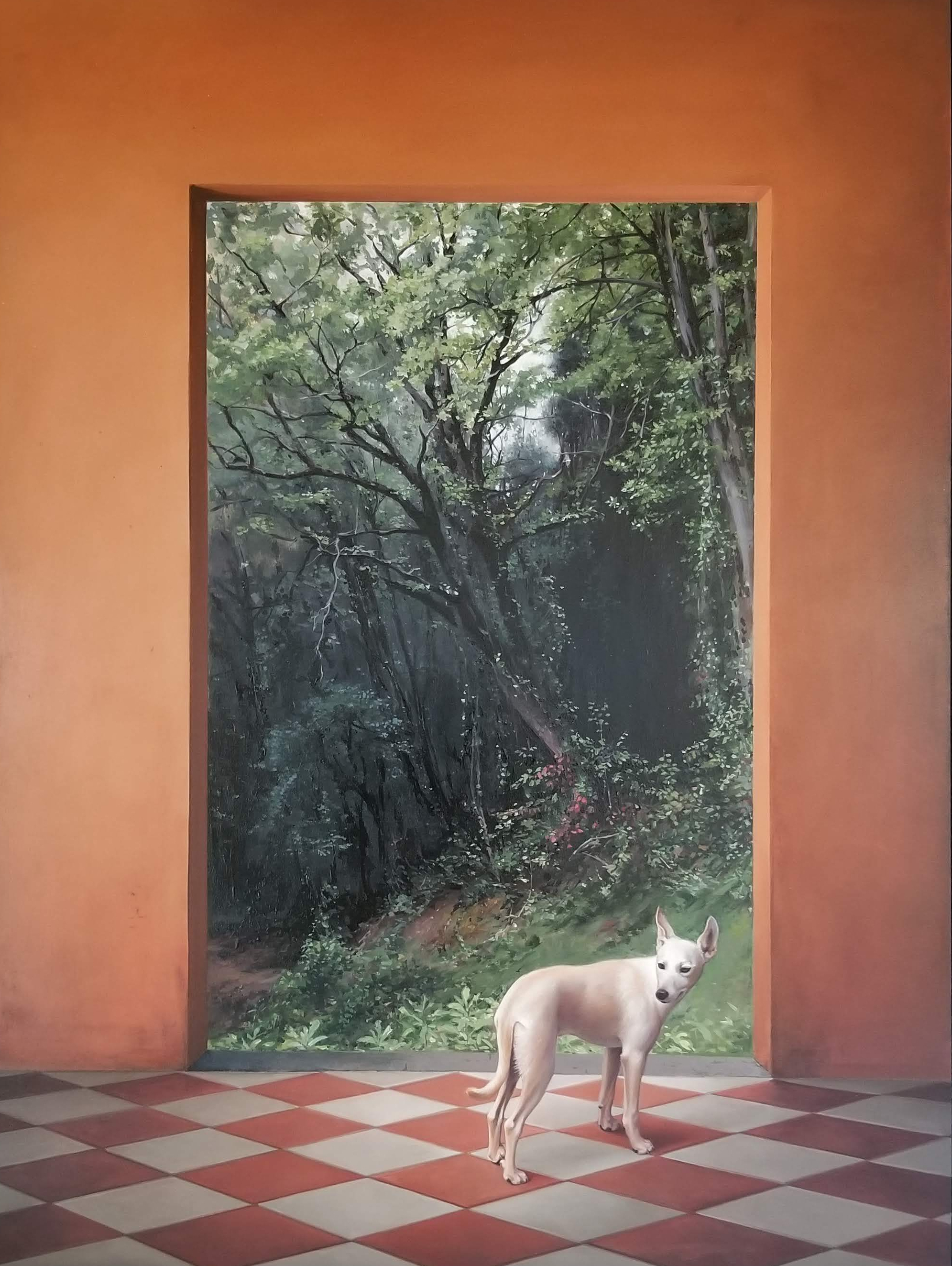
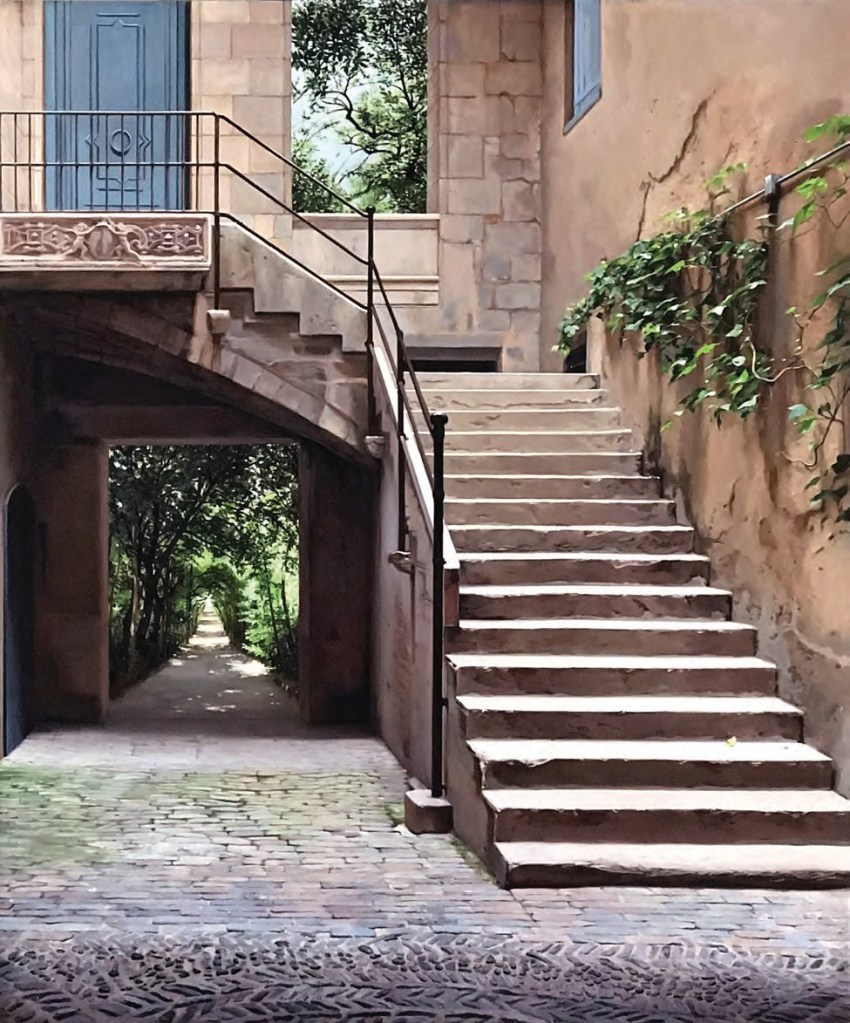
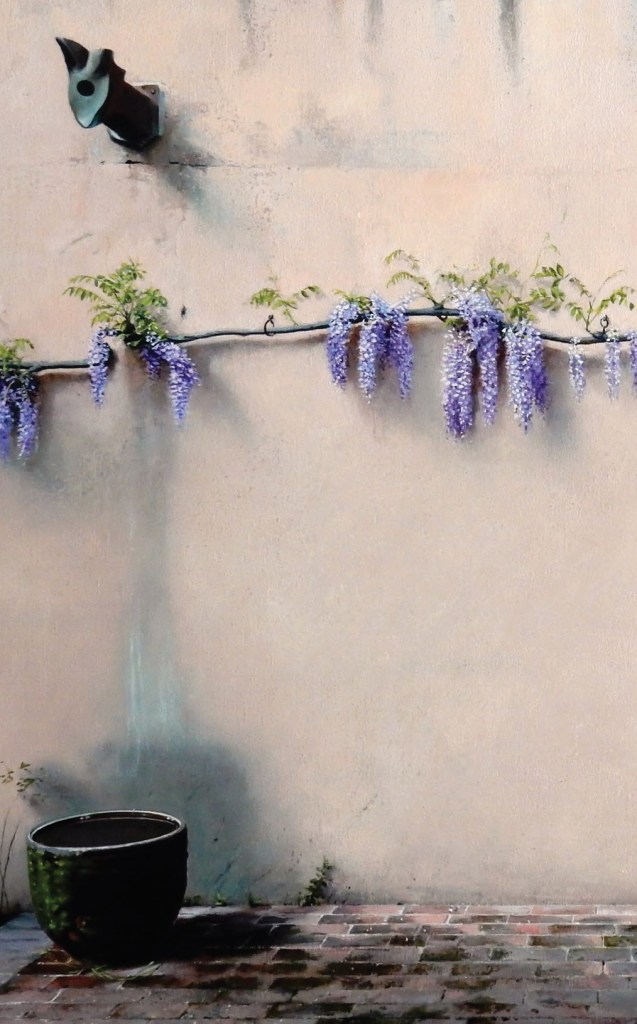
The paintings in Carol Pylant’s Portals series present quiet and formal spaces inhabited only sometimes by dogs or peacocks, statuary, or figures carved in relief. The titular portals are doorways and windows that open onto landscapes, some wooded, others lake views, some frozen, some misted, and yet others on fire. These places are gorgeously, meticulously rendered—once the artist’s process is understood they could also be appropriately described as painstakingly detailed. In this detail they are mesmerizing, but the illusion of reality that is presented is disorienting. Pylant is a tremendously skilled painter. The power of the works lies not only in their careful style, it is also in the construction of unnerving scenes that operate via a disjunction: although the pictured places are not real and the settings are simply not possible, there is a connection to a reality of some sort, as the works are based on actual places. This disconnect between the real and the imaginary is magical.
The works can be understood as stage-like. The settings show signs of age but are within indeterminate, and thus suspended, time. Certainly there is a potential for action in the emptiness of the architectural spaces, but also in the invitation offered by open windows and doorways, paths leading off into woods or views of lakes with far shores. The opportunity for exploration of the space beyond is potent, as the represented landscapes are not clean and ordered like the foreground spaces, but instead are undefined, unmarked, unidentifiable by landmarks or other distinguishing features. Some of the landscapes have clear paths presented, others have no clear entry discernible, but all provide a marked contrast to the symmetry, quiet, and weight of the architectural spaces.
Carol Pylant, The Path
What is represented is not the simplistic dichotomy of outside/inside or nature/culture. These architectural spaces are places that Pylant has seen or visited or lived. The same is true with the landscapes: North Carolina, Ireland, Spain, Italy, and Wisconsin. The personal experience is here made real, not simply the act of visiting and remembering these places, but in connecting them, overlapping them, collaging them together to form something new, something different than a memory. As a mash up of former residences and travels, the paintings become a visualization of the act of remembering, of mental life. More than just locations, they are a map of experiences, lived and seen. What breaks the dichotomy and launches the works beyond a simple matchup of disconnected architecture and landscape is the sense of waiting, of impending action or unspoken words that permeate the represented spaces. Not a nostalgia for lost places, but rather the potential for narrative and its related act of sense-making is what is conveyed by the works: what and how we remember, how we make connections, the stories we create as our minds leap between seemingly disparate elements, places, and things; how the very activity of accounting or chronicling makes memory and shapes it into useful bits.
Carol Pylant, Eternal Spring
These are not simply pictures from the artist’s memory, postcards or souvenirs of world travel. Rather, the paintings are sites where memory and place are put to work and utilized for altogether different purposes. Where are these places? In Pylant’s memory they are tied to distinct experiences. But what do they mean, how can they function, for anyone other than the artist? When represented so distinctly, when combined unexpectedly, these disparate locations lose their individual identities and become resting places, temporary holds, places where time is suspended, where stories can be formulated. They are transitional spaces, the boundary between the formal and the unkempt, the ordered and the wild, the confined and the free. They are specific enough for a viewer to imaginatively inhabit, but have just enough disruption to generate unease and thus a desire to get moving.
Carol Pylant, Duende
What is intriguing about the work is why an artist would be interested in representing liminal spaces. In the choice of not telling a specific story, but creating instead spaces where narrative can be formulated, Pylant reveals something about herself. As a teacher she created very real spaces for her students to develop their own storytelling techniques; perhaps these settings were created to make space for her own personal acts of remembering and understanding. In the disconnect between the aging archways, carved figures, checkerboard floors and quiet dogs, the dense woods or open bays and distant hills, Pylant uncovers the opportunity to engage quietly, the option for thoughtfulness, and calm consideration. She represents pause, which is here exposed as an inhabitable place, attractive, and rich with potential.






 Ann Sinfield: Projects