Celebrating Connection

Lucas_Koehler_Combo
Lucas Koehler Combo, Union Hair Parlor, ALL Jazz Fest 2018, Schenk’s Corners.

On top of a recent realization about some professional fails, mostly surrounding communication and an inability to see clearly, the other day I took 10 minutes and three trips down the hall to print one shipping label. This was yet another clear failure: too much time to complete a (usually) simple task.

As failures go–especially when compared to the rest of the day’s realizations–the label printing was relatively low-impact: a time-waster and frustrating, but that’s about the extent of the damage. Luckily the day ended with some local jazz: #thebestjazzisinhairsalons fully expresses the restorative, rejuvenating, community experience that provided me with much-needed perspective and release after a difficult week.

Of course there are other failures, some of remarkable scale, with a much much larger impact that can’t be remedied by jazz, no matter how awesome the music. A highlight of my difficult week was the opportunity to hear from someone who headed up one such spectacle, Jim Lasko of the now-closed RedMoon Theater. In a conversation with the Chazen’s director, Amy Gilman, Jim talked about the social impulse of his theater work which, at RedMoon, took the form of taking theater into the neighborhoods and streets of Chicago, in his words, “engineering new ways of being together.” The motivation was to make theater more accessible and bring performance to bigger, different audiences.

But Jim was not at the art museum to talk about street theater. He was invited because of what has been identified as a massive fail: the Great Chicago Fire Festival of 2014. I won’t rehash the story here, as it has been amply covered elsewhere–Jim has even talked and written about the event and the aftermath. I am more interested in his process of recovery, how he moved forward, and his perspective on creative work.

Jim talked of theater as a living activity, he compared it to a group jumping out of an airplane. With opening night the equivalent of the ground quickly approaching, the group has to work together intensely, and fast, to prevent disaster. The joy and excitement is in that process of making, of attempting and failing and trying again. It is thrilling, it is inspirational. We make art because we have to, we are driven to keep attempting it over and over. We fail every day, which is an important thing to remember as we get up and try again. But aside from the daily face-plants, in the wake of massive fail, what makes us pick up the pieces and try it again?

After the closure of RedMoon, Jim says he talked to many people about his next steps. He talked about failure to corporate groups, and he returned to work on an unfinished PhD. Recently he teamed up to open a new maker and gathering space called GuildRow.

After the presentation I was able to ask Jim about the recovery, the aftermath. He had talked about it in personal terms in the conversation on stage, but I wanted to know how his team responded, and how they, as a group, recovered after hitting the ground so hard. After some thought he revealed something about the theater company that was striking: he said they worked through the difficulties because they loved each other. A company like RedMoon that was dedicated to bringing theater outside, into neighborhoods, and making it participatory, this company was comprised of intensely committed individuals who fiercely loved their work. They ran on a personal devotion to shared goals and to each other. This is not, of course, every organization. But it seems completely reasonable, maybe even necessary, for a non-profit street theater group.

I am intrigued that Jim emphasized the personal in his presentation. He was not there to talk about failure. His comprehension is contrary to the corporate lingo approach to failure which, through it’s focus on venture capital, minimizes and even erases the personal–the pain and suffering, the lived experience, the frustration, anger, and confusion. But in Jim’s telling was a sense of a community, not only within the active theater company, but following the disaster. He described turning to his personal community to assess and advise, to consider and imagine. This was a way of doing important individual work, human work. It is restorative, it is personal, and it is vitally important.

Which takes me to a different theater project that I was lucky to witness recently, here in Madison. Lines: A Theatre LILA Invention is a collaboratively written play that gives voice to five female playwrights of color. The play was a complex intertwining of stories, with actors playing multiple roles. The beauty of the play was not only in the acting, the staging, and the direction, but in the stories that were told. These are voices that are rarely heard in theater: beauty shop conversations, playground interactions, hopscotch, hope for the future, lovers’ arguments, the daily dangers of being a woman, black, lesbian, latina, muslim, young, or even middle-aged.

It was a play that conveyed the personal, but also emphasized the importance of connections and the potential of community, not only in how the play was created or what was represented on stage, but in the conversations with the audience that followed. This is the same force behind Jim Lasko’s theatrical efforts: a desire to connect. In moving performance outside into the street, or by collaboratively developing a script with other writers of color, these efforts expand the reach of theater. They breathe in deeply and open their arms, inviting more people into their embrace. They grow the audience.

Although connections can be uncomfortable, as with some of the questions that were asked during the talkback after the Lines performance, or in the direct personal challenges that were issued during the play, they are essential for the success of art making. I imagine that for some people, like those who enjoy the anonymity of a dark theater, RedMoon’s street performances would have been quite difficult. But connection takes many shapes. Engagement may be a buzzword, but we use it for a reason. Lasting impressions–wonder–happens when people are able to connect, with each other, with art, with music, with something outside of themselves.

These theater efforts are so different, yet both relied on the very personal dedication of their members. Understanding this devotion and commitment transforms notions of success and failure. A fizzled public art event is insignificant when the connections created through it, or the exhibition of an artist’s work, a collaborative theater event, or even a jazz celebration (pictured above), are prioritized. Instead of focusing on failure, maybe it’s is more important to foreground engagement and connection, and their restorative, sustaining potential. Who did you connect with today? We fail daily, but so do we achieve. Connecting every day, staying engaged, that’s the hard part. But when it happens? Wow.
 

All Quiet in Austin, Despite the Noise of Color

Dan Ramirez has ruined how I look at art. And by “ruined,” I mean “demolished.” How could I have known that working with him would lead me to this embarrassing point where I find myself saying, aloud, “I love minimalism.” It’s horrifying.

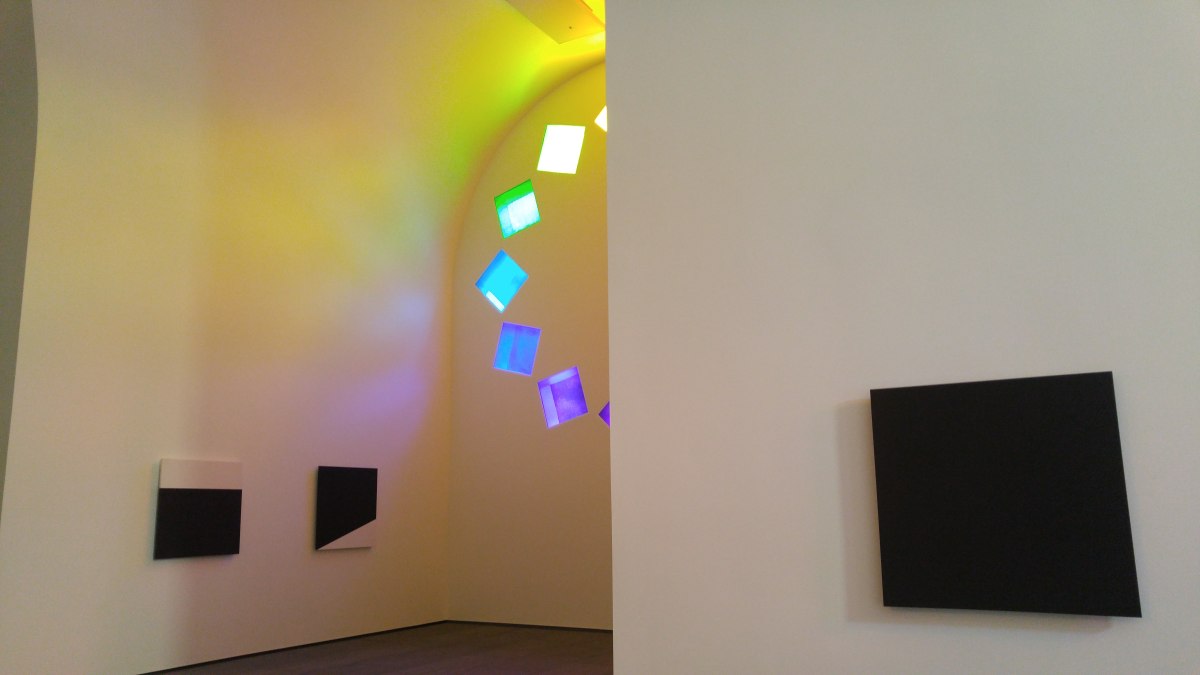
Just look at the exhibition currently on view the Blanton Museum of Art, Form into Spirit: Ellsworth Kelly’s Austin (February 18, 2018 – April 29, 2018). Organized in support of the opening of Austin, Kelly’s building/installation on the UT campus, the exhibition is all of the things a university art museum exhibition should be: informative, interesting, nicely installed, well-researched, etc. It is also astoundingly beautiful.

Yes, gorgeous. Which I didn’t expect. And although this is probably a career-killing thing to admit, I was not mesmerized by the color in the exhibition (I know, it’s Ellsworth Kelly! How can anyone not be astounded by his exploration of color?). Instead, it was the black and white prints and sketches that took away my ability to think clearly.

The prints are large, and in a brave and aggressive decision, hung 3-high by 8-across. Although this arrangement makes them nearly impossible to see individually, and difficult to appropriately light, it does emphasize the expressive power of the group as a whole. The repetition of the black and white forms, with such a deep blackness of the ink on the paper, along with the scale of their printing, makes the group quietly coercive (I could go on about the prints, but it would be far better to look to the important work done for a 2013 exhibition and publication at MMOCA here in Madison). Then there are sketches of the stations of the cross, all black and white, all concentrated power in a small format.

This force is continued by the upright sculptural totems that are grouped nearby. Towering and simple in form, their differing media (redwood, metal) make no difference in their individual ability to convey solemnity and presence.

20180406_133046

The meditative and quiet are continuous throughout the exhibition and–outside, down the path, through the enormous wood doors–into the work Austin, where the black and white forms are softened as they are translated into marble, and color becomes light that falls over the walls of the building. A redwood totem stands over the space, not lit but still dominating from one of the alcoves. The quiet, the repeated forms, the simplicity of shape, all create a foundation to support all of that color play. It’s a completely mesmerizing structure.

(My images here are terrible. For better views see articles in the NYT, Architectural Digest, Texas Monthly, or ArtNet News. Or, for a more in-depth discussion about the background of the structure, see the 2012 lecture–from before the work was realized in Texas–at the Haus der Kunst by Carter Foster, then at the Whitney, now at the Blanton).

Of course I think of Dan Ramirez’ Twenty Contemplations prints. The repeated black and white, the sense of space and depth that each artist captured using a restricted palette and carefully honed forms, the feel of the paper saturated in ink. I’m skipping over the subject matter here—stations of the cross, devotional music—but I’m less interested in the specific iconography. It’s a very noisy world, and to be in a place where the mind quiets and the world opens, well, it’s just doesn’t happen very often.

Get yourself to Austin.


The River

Velarde detail.jpg
Kukuli Velarde, Sta. Chingada: The Perfect Little Woman (detail), 2006. Private Collection.

Last week I attended a play-reading at American Players Theater in Spring Green, WI. Their Winter Words performances are few in number, but held in the small theater these evening events feel like super-secret meetings of an artistic Justice League—heartfelt, dazzling, and sincere. The readings are simply staged and completely engaging, as they are followed by talkbalks with the audience, cast, and director. They are a wonderful and rare experience.

This episode featured a small cast and the director Robert Ramirez presenting The River Bride, a graceful and gorgeous play by Marisela Treviño Orta. As just a reading—no set, costumes, or larger theater magic—the words and story were in the spotlight, all achingly beautiful, devastating, yet hopeful. I’m not sure if I care to ever see this play staged, as this reading by these actors has taken up residence in my mind and promises to stay for a very long time.

Driving back through the night along dark country roads, the carload of theater-goers analyzed the play. Some agreed with the director, that the main focus of the fable was the failure to seize the day and act upon dreams and desires. I was convinced that the selfishness and greed of one character drove the story, impacting all the other characters. But I have changed my mind. I see now that the heart of the drama is indeed a failure of nerve, of effort, of voice, and specifically, how such hesitation clears a damaging path for the overly ambitious.

And here is where I relate a beautiful, poetic play to a business book.

In my workplace, we have a new boss who brings contemporary management tools and techniques into a museum setting. Every day is refreshing, yet also challenging. Just one example: the staff has read and discussed a few chapters of Kim Scott’s Silicon Valley new hope rah rah manifesto, Radical Candor. Reading a management book in no way approaches the joyful aesthetic experience of hearing Treviño Orta’s play read aloud, but these texts have an important commonality: they both consider what happens when individuals seize too much, too often; the damage and destruction that result from an imbalance of power when aggression is not checked consistently—and, most importantly, the mediating potential for persistent assertiveness.

Is it wrong to hold onto the heartache that is at the center of The River Bride, to utilize a fictional loss as a spur to action, at work? To transform Helena and her hesitation into a warning about professional silence and complicity? Can poetry be combined with the dictates of management? Carpe diem? “Care personally, challenge directly” is Scott’s mantra to transform relationships, and thus the workplace. And I am beginning to see some truth there. Balancing personal ambitions with candid feedback and daily responsibilities is challenging, but actually made easier if you care about what you are doing.

A fable set in the Amazon informs activities in a midwestern office. This is the reason I work with visual art, why I see plays and movies, read poetry, and yes, even business management books: to better understand life, its conflicts, complexities, and incongruities. To drive for hours through the dark night, talking about language and people and meaning and motivation, then discover new angles on these same issues in the bright light of the workplace, the experience of the play is extended, the words sing again and again. This is on my mind as I prepare for a truly exciting professional development experience. I see that my office is on the edge of a river, filled with the calls of the birds and the clicking of the dolphins, home to much noisy, productive, difficult, and promising work.