Diversity Funding and Collaborations: Signs of Change?

The following article was published (with some revisions) in the March/April 2019 issue of the New Art Examiner.


It’s been a busy few years for large initiatives within the art museum field around efforts to improve diversity, equity and inclusion. This January alone saw three major announcements addressing these issues. The efforts included survey reports, substantially funded programs, and collaborative projects with resource toolkits. There has also been important social media participation and less formal group efforts from within museums and other supportive communities.

The efforts are welcome signs. Let’s review a few of these efforts from a museum worker’s perspective. It is important for museum insiders to consider the potential impacts of these efforts, as they are related to two recent realizations within the field: first, museums are not inherently equitable places and, second, museums need to reconsider their practices if they want to survive within dramatically changing
funding structures and cultural demographics.

My focus here is on hiring practices because, ultimately, museums change or remain the same because of the people who lead them and who work in them. Funding and external efforts of course impact museums, for example, women have finally been hired to lead two national museums: the National Gallery of Art, and the Smithsonian’s National Museum of American History. These hires happened for many reasons, including perhaps the attention brought by #MeToo, but ultimately it was insiders who made decisions. Are these hires inspiring for the field? Of course! Will they impact the fight for equity within museums in this country? This is yet to be seen.

Plenty of digital ink has already been spilled about the 2015 Mellon Foundation Art Museum Staff Demographic Survey. This project put numbers to what many museum workers already knew: with 84% of museum leadership positions occupied by “White (Not Hispanic)” individuals, the stark reality is that there are very few people of color in influential positions at this country’s art museums. The more important finding of the survey related not to the current situation, but to potential opportunities for change. The data portrayed a depressing future, with consistently low numbers of people of color stretching across all generations of museum staffing. The result? There was no large, developing cohort of emerging museum leaders of color. The numbers were the same in the younger and older generations.

In response to the demoralizing news of the 2015 Mellon survey, some large funders and professional organizations stepped up to partner on a variety of attempts to change the course of the #MuseumsSoWhite leviathan:

  • In November of 2017 the Diversifying Art Museum Leadership Initiative announced its intention to provide $6 million over 3 years to “support innovative strategies and programs to advance diversity” across the field. Funded by the Ford Foundation and Walton Family Foundation, the projects are focused mostly on educational and professional development efforts, and include internships, fellowships, and youth leadership programs at 20 museums across the country.
  • In July of 2018 the Association of Art Museum Directors announced the AAMD College Students from Underrepresented Communities Internship. This is a pilot program intending to “engage undergraduate students from underrepresented backgrounds and nurture their career opportunities in the art museum field.” With support from the NEA and AAMD, the program will offer paid, project-based internships during the summer of 2019. Including mentoring and attendance at professional conferences, the interns will work in exhibitions, evaluation, programming, communications, curatorial, and outreach at 10 academic and municipal museums. The only Midwestern museum awarded an internship happens to be my former employer, the Chazen Museum of Art, at the University of Wisconsin-Madison.
  • Announced on January 15, 2019, the American Alliance of Museums’ National Museum Board Diversity and Inclusion Initiative will provide $4 million in grants from three foundations (the Andrew W. Mellon Foundation, Alice L. Walton Foundation, and Ford Foundation) to “provide the framework, training, and resources for museum leaders to build inclusive cultures within their institutions that more accurately reflect the communities they serve.” Along with offering the usual AAM standards, sample documents, and case studies, the initiative will also provide support to 50 museums for “the development and implementation of sustainable inclusion plans.” Interestingly, also promised is a new tool to connect interested individuals with boards who are expanding their pool of talent.

Two follow-ups to the 2015 survey were also released in January of 2019 by the Mellon Foundation. The first is a series of case studies that demonstrate successful diversity efforts; the second is a 2018 update to the initial survey:

  • Intended to showcase institutions that “have been successful in their diversity, equity, and inclusion efforts,” Case Studies in Museum Diversity, by the cultural sector consultant Ithaka S+R, in partnership with The Andrew W. Mellon Foundation and the Association of Art Museum Directors, provides an in-depth consideration of 8 different museums. Based on staff and constituent interviews, observations, and additional outside research, the findings are individualized, but they are also more generally useful. Two notable examples in the report are the MCA Chicago and Spelman College, where efforts to increase collaborations and build curatorial pathways have been developed, prioritized, and most importantly, are receiving funding attention.
  • The Art Museum Staff Demographic Survey 2018 is a progress report that follows up and expands upon the 2015 effort. Although there is much excitement about the changes after only a couple of years, I see the results as mixed: the field remains majority female, yet directors are still mostly male; educators are now 26% people of color and mostly women at all levels of responsibility; people of color have been hired at an increased rate, from 26% in 2015 to 35% in 2018; and although museum staff have become slightly more racially and ethnically diverse—the numbers of people of color increasing by 4% overall, and the number of African American curators doubled, for example—museum leadership, at 88%, is still very white.

These partnership efforts by big funders and professional organizations are significant, because it is clear that knowing about the demographic disparities does not always translate into action. When major funders in the humanities are devoting resources to making change, I am stunned by how long it takes for associated organizations to get the message. For example, a well-known museum leadership training program offers, according to their website, executive education “for the next generation of museum leaders,” but fails to address diversity, inclusion and equity in its curriculum. To provide leadership training that lacks basic DEI concepts is not only short-sighted, it is dangerous. This is an omission that demonstrates a continued willful ignorance of the museum field’s colonial beginnings.

Beyond the data, the inherent inequities in museums are dramatically demonstrated by more localized efforts to making museums responsive to current events. Related to the move to decolonize museums, social media engagements like #MuseumsAreNotNeutral are making the field conscious of its histories and roles. MASS Action is a collaborative project of museum staff (or “museum practitioners” as described on the website) who seek “to align museums with more equitable and inclusive practices.” Some of the questions the project pursues include the role and responsibility of the museum in responding to issues affecting communities, how to align the museum’s internal practices and their public practice, and considerations of how the museum can become a site for social action. It is important to note that this movement is not originating within museum leadership or funders: it is staff and people without much power who are joining together to redefine what their museums do.

Will the recent collaborations between professional organizations and big money affect much change? The 10 interns, 20 museum programs, and 50 museum boards that are seeded with these investments will hopefully see some improvement, and, optimistically, there will be positive, larger impacts as these seeds take root—the 2018 survey already demonstrates some progress. But, for perspective, art museums make up only 4.5% of the over 35,000 museums in the US that employ over 726,000 people. If museums are unable to make their hiring practices more responsive without relying on substantial help from big funders, it’s not clear how leadership, programming, collections, and exhibitions will ever become more inclusive. There is simply not enough philanthropy to support change on such a scale.

Why are museums waiting for big funders to lead the way? Puawai Cairns, Head of the taonga Māori collection, Museum of New Zealand Te Papa Tongarewa, has written, it’s like “throwing fertiliser at our feet–we can grow or we can stand still and wallow in sh*t.” How long will museums stand in place, depending on generous funders to motivate change? Funding creates opportunity, certainly, but it will take more than money to secure sustained movement. Lasting transformations in diversity, equity and inclusion require clear priorities that stretch into all areas of practice. Make it part of the mission, and work to make it happen.
 

Word & Image, Song & Story

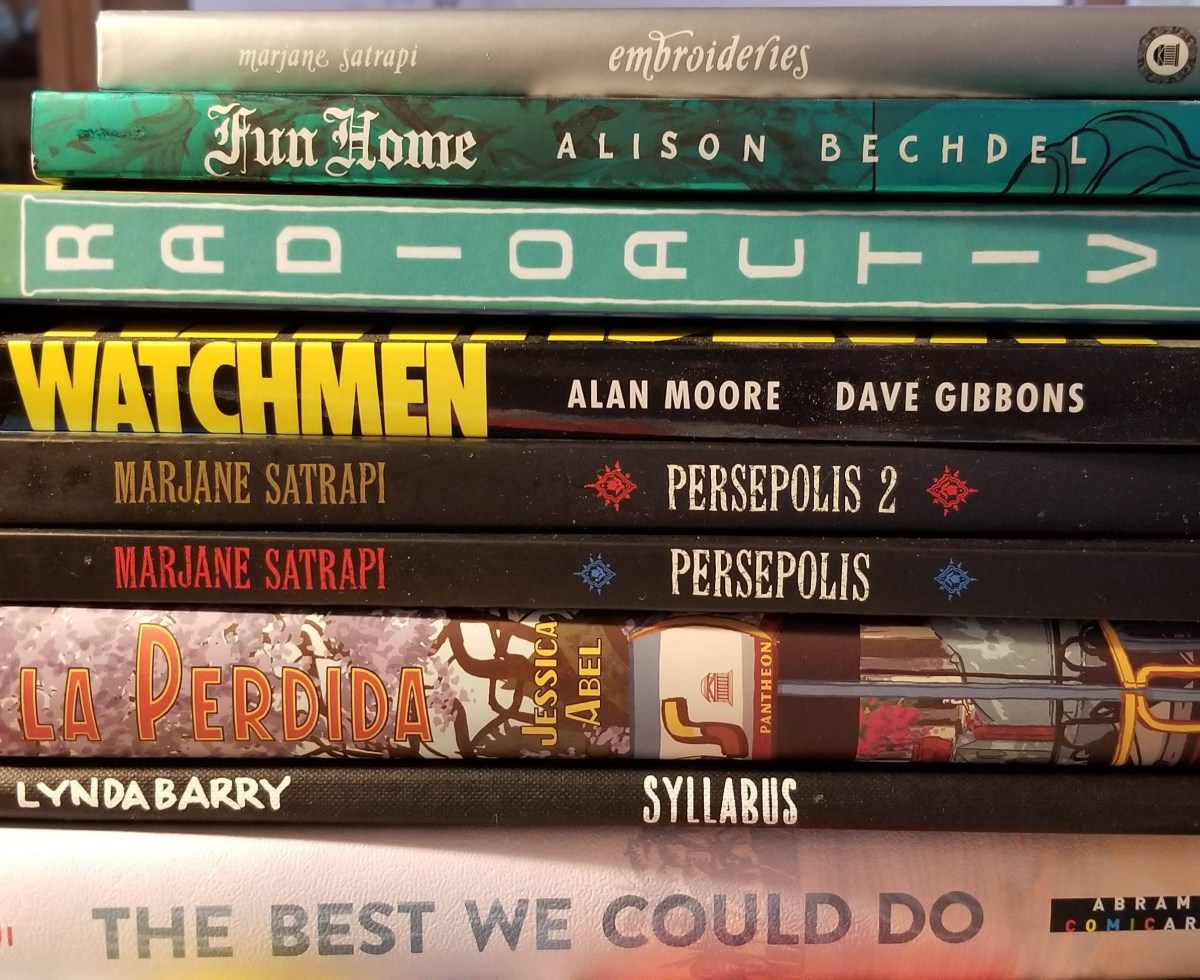
Fun Home was on stage at the Forward Theater here in Madison during the fall. I was excited to see the play, and was curious to learn how this funny yet intense graphic novel about personal identity and unpacking familial mythology would translate into musical theater. How better to present a sensitive, heart-rending story about an artist figuring out who she is in relation to the loss of her father, than on a small stage, with a packed house and marvelous actors, and a musical score? It could be called genre-busting. But after seeing the play, having the chance to listen to some other old soundtrack chestnuts, and diving back into a few favorite graphic novels, I wonder if maybe musicals and comics have always been places for difficult stories. Loaded with drama and pain, yet punctuated with real joy, this play might just be the inevitable coming together of seemingly disparate artistic forms.

Musical theater is the natural home for wrenching heartbreak. I was reminded of this when, for reasons of nostalgia—or possibly in an attempt to distract me during a card game–I was recently subjected to not one, but two dramatic, emotional soundtracks: Camelot (original Broadway cast), and Les Miserables (original London cast). The distraction was perhaps effective (or it might have been just a lucky win for the kid), but the impact of this music persisted beyond the usual earworm.

Camelot
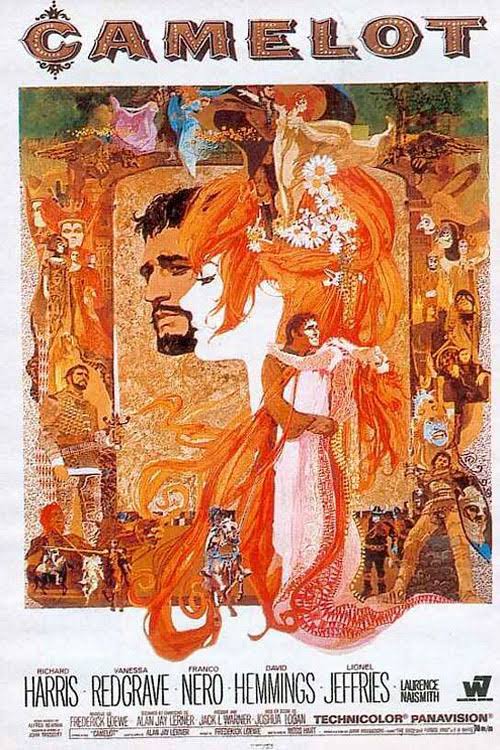
Camelot (1967)

Camelot. Wrenching heartbreak? Isn’t that just a silly 1960s Richard Harris and Vanessa Redgrave movie spectacle, with medieval hippies flitting about the English countryside/sound stage, playing at courtly ladies and knights? Sure, but at its heart, Camelot is a tragedy, a tale of the failure to contain evil, the devastating fall of a culture centered on love and joy. The play was based, of course, on T.H. White’s The Once and Future King, whose story humanized its medieval characters in a consideration of political ambition, emotional devotion, and utopian yearnings. Toss in some dreamy love songs, armored masculine posturing, and conniving offspring, and you have one complicated story-telling apparatus. I could go on about the similar structure underlying Les Mis–love, faith, greed, revolution–but my experience of this play is too heavily skewed. My 20-year-old-self shed a lot of tears during the production I had the privilege of experiencing in London; I still can’t consider this play separate from my original context for it. 

Although musicals have always easily handled complex storytelling, Fun Home is not just another excellent example. Something else happens in this play when a graphic novel is incorporated into a stage experience. This isn’t just a play with actors telling a story. This is a play that shows an artist creating a work. When the adult Alison is on stage, watching the the scenes from her childhood and drawing what she sees, the play seamlessly melds two mediums: drawing and acting. While the story unfolds the audience sees the artist remembering and recording and creating. The stage presentation captures something that is so central in the structure of the novel: the act of drawing that not only frames the difficult narrative, but is it’s very telling. It is in the remembering and drawing where Alison finds her story. On stage, the art-making and the theater experiences are so cohesive, so neatly intertwined. What is accomplished in their close integration is a view into the experience of memory and creation. The activities involved in discovery, sense-making, and understanding are the very story that is presented in this play.

Other graphic novels have certainly handled complex and challenging stories. With visual elements emphasizing concepts that would be lost in pure text formats, the graphic novel is a powerful medium for difficult narratives. The images of water in Thi Bui’s The Best We Could Do, the laughter and faces of the women in Marjane Satrapi’s books; the cityscapes in Brian Selznick’s Wonderstruck or Jessica Abel’s La Perdida–these novels present personal narratives, visual and textual, some autobiographical, all beautifully drawn, hilarious, scary, fun, and heart-breaking.

But the form can also powerfully transform the presentation of technical material. In Radioactive, Lauren Redniss not only combines biography, history, and science education, she accomplishes this using a format that pays homage to the work of her subject, Marie Curie. By turning to drawings on cyanotypes, the work references the photographic exposure that was critical to the discovery of radiation. Its physical form is an important element in how the book is able to convey its story.

At UW-Madison, the cartoonist Lynda Barry is using drawing to explore the creative process with not only artists, but scientists. Her students have created the Applied Comics Kitchen, but there are also other efforts in visual science communication around Madison, such as JKX Comics.  It’s amazing, fascinating stuff. This is not just about images, these are explorations into different kinds of stories and story-telling.

lyndabarry_syllabus1

It is exciting to see compound productions like this–graphic novels and theater,  storytelling that is both visual and physical. The combination of text and image, music and communication, it’s an interdisciplinarity that is so powerful. I’m not talented enough to ever be as moving and charismatic as Karen Olivio and the two younger actresses I saw in the role of Alison, but few people ever really get to that level. I do, though, think about story-telling, about how to explore and better represent complex narratives. I’m not sure my answers will necessarily involve singing (actually, I am quite certain they will not), but there are so many other forms available. A wide-ranging consideration is an important place to start.


Process and Making: The Intellectual Power of Personal Adornment

What is it about original, handmade jewelry? Pieces purchased directly from artists, the chance to visit in the studio, to get a glimpse of the process? I am lucky. I own jewelry that has been purchased directly from artists, some picked up in studios, others at art fairs, or online. Weirdly, happily, wonderfully, I have ended up with a number of works, acquired by purchase or gift, by Madison-area artist Teresa Faris.

I have wanted to write about Faris’ work for a long time. A metalsmith here in Madison, Faris teaches at UW-Whitewater and makes compelling, visually engaging jewelry. She is an artist who works in an art form that can be functional (worn), but who pushes her material and its expectations in decidedly non-functional directions with a process that excavates and increases the medium’s capacity to convey meaning.

Faris is not alone in this effort to crack open the world of jewelry and stoke its expressive power. Many artists in recent years have been traveling on this same path. The exhibition that just opened at the Chazen this weekend, Shelter: Crafting a Safe Home (organized by Contemporary Craft in Pittsburgh), includes work by two other jewelry artists who are exploring this same, meaning-laden landscape, Motoko Furuhashi (another HSU grad!) and Demitra Thomloudis (an SDSU MFA). Although centered on different issues, all three of these artists utilize metal, in combination with other materials, to expand beyond beauty and decoration. In their work they contemplate physical space, personal identity, and the expressive power of experience, process and making.

20181121_0952551.jpg
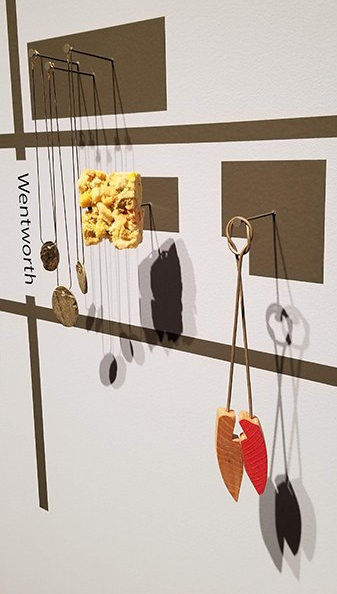
Demitra Thomloudis, Houston Yellow Tape Project (detail), installed at Chazen Museum of Art, November 2018

In Houston Yellow Tape Project, a work included in the Shelter exhibition, Thomloudis presents a street map of a neighborhood that identifies only sites where homes have been torn-down. The map is enhanced by individual jewelry pieces that hang from the highlighted lots. The jewelry is an unexpected addition to the map, acting almost as game pieces, like the small metal shoe or top hat place-holders that occupy squares, indicating presence on a Monopoly board. Here they hang in front of a simple graphic of streets and lots. Some pieces are obvious as jewelry–pendants on chains, necklaces, brooches–but their materials deny expectations: some are constructed out of upholstery foam, others distressed wood, plastic, or unknown items.

The individual pieces are crafted of debris from the houses whose sites they mark. Thomloudis has gathered specific construction detritus and created functional works. The works serve as memorials to the demolished homes and to the neighborhood’s loss. They also, according to the artist, are intended to provide points of connection between people when worn, as conversation starters, as a means to connect and educate and share stories of what is gone.

Furuhashi is interested in similar ideas of place and specificity. The brooches and necklace that are included in the exhibition do not indicate loss, but rather utilize overlooked materials to redefine a sense of place. The artist takes map views and translates them into jewelry supports: street grids become the structure for brooches or the underlying organizational scheme of a necklace. The works are bejeweled not by precious stones, but by chunks of asphalt and concrete that have been excavated from locations noted within the mapped sites.

In combining a bird’s eye perspective and site-specific materials, Furuhashi creates abstracted portraits of places. Physical experience is represented in these works: a locating of self within a particular time, a network of streets; the steel and asphalt that support movement through the space are humble yet ubiquitous and powerful materials, they shape and underlie every passage.

https://teresafaris.com/artwork/4315157-Collaboration-with-a-Bird-V-10.html
Teresa Faris, Collaboration with a Bird V, #10, Sterling silver, wood altered by a bird, 7″ x 3″ x 1′ (pendant), 2017

Faris explores not a physical site but instead an emotional landscape. She finds meaning in intricate labor: crafting chains, sawing, riveting, and punching to create a calming, meditative space. In her work, the artist’s repetitive motions are related to the chewing and carving activity of a captive animal, specifically, the cockatoo who shares her home. Incorporating the brightly colored chews into elaborately sawn metalwork, Faris makes Collaborations with Bird, a series of works that pairs the productive output of co-located beings. Anxieties about personal well-being are considered in human and animal terms, equated, and found to be analogous in expression.

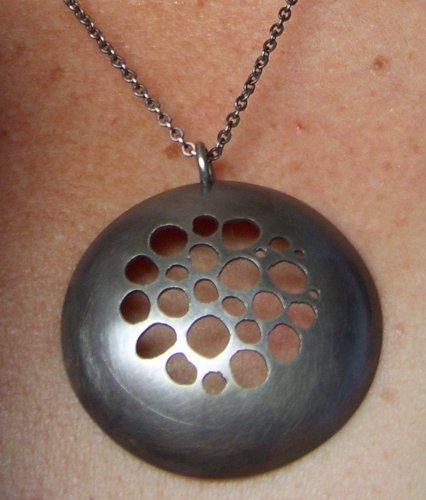
A similar focus on repeated actions is evident in a more recent series, CWaB:Lien. Exploring ancestral debt and assimilation, these works are punched and dapped, then soldered together into large swaths of small circular forms. The end result is stunning: glittering, seemingly cohesive silver bits connected into what appear to be sturdy medallions. But are they solid? What is behind that process of connection, integration, of piecing together, of fitting in? What is omitted in the creation of a homogenous group? What, if we consider our debts, is our inherited legacy?

43d20ae33e0d7213e0a9517869b2b5e2
Teresa Faris, CWaB:Lien #1, Sterling silver, reclaimed Comfy Perch™ 6″ x 3″ x 1″ (pendant), 2018

It is this focus on the overlooked or unconsidered that connects the work of Thomloudis, Furuhashi, and–although not part of the Shelter exhibtion–Faris. All three artists utilize jewelry to refocus attention, to turn away from decoration towards more complex considerations. Not items merely to be worn, the pieces are meaningful because of their external referents–they are visually arresting and conceptually weighty. These metal and wood constructions relocate the wearer: we are moved away from surface beauty to a place where personal adornment becomes a powerful intellectual presence that conveys astonishing expressive potential.

5142_1185893646360_3785802_n
Teresa Faris pendant

(update: listen to an interview with me about the Shelter exhibition that aired on Sunday Afternoon Live, December 1, 2018).

(update 2: see a blogpost on the textiles in the Shelter exhibition, on the Chazen Museum of Art website).