Word & Image, Song & Story

Fun Home was on stage at the Forward Theater here in Madison during the fall. I was excited to see the play, and was curious to learn how this funny yet intense graphic novel about personal identity and unpacking familial mythology would translate into musical theater. How better to present a sensitive, heart-rending story about an artist figuring out who she is in relation to the loss of her father, than on a small stage, with a packed house and marvelous actors, and a musical score? It could be called genre-busting. But after seeing the play, having the chance to listen to some other old soundtrack chestnuts, and diving back into a few favorite graphic novels, I wonder if maybe musicals and comics have always been places for difficult stories. Loaded with drama and pain, yet punctuated with real joy, this play might just be the inevitable coming together of seemingly disparate artistic forms.

Musical theater is the natural home for wrenching heartbreak. I was reminded of this when, for reasons of nostalgia—or possibly in an attempt to distract me during a card game–I was recently subjected to not one, but two dramatic, emotional soundtracks: Camelot (original Broadway cast), and Les Miserables (original London cast). The distraction was perhaps effective (or it might have been just a lucky win for the kid), but the impact of this music persisted beyond the usual earworm.
Camelot
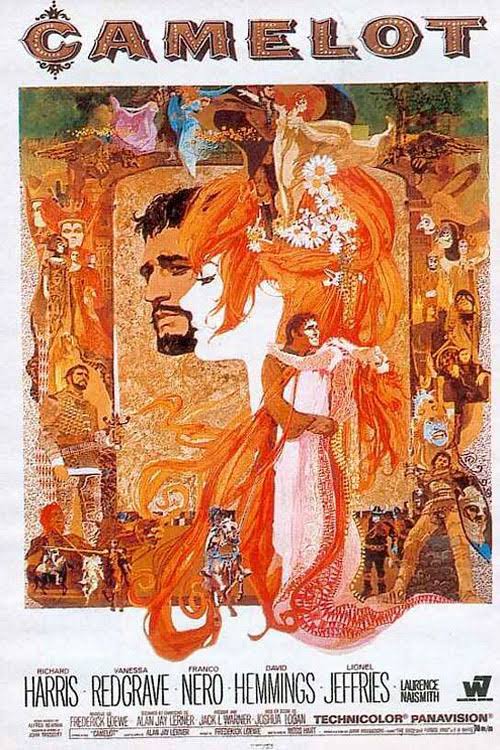
Camelot (1967)

Camelot. Wrenching heartbreak? Isn’t that just a silly 1960s Richard Harris and Vanessa Redgrave movie spectacle, with medieval hippies flitting about the English countryside/sound stage, playing at courtly ladies and knights? Sure, but at its heart, Camelot is a tragedy, a tale of the failure to contain evil, the devastating fall of a culture centered on love and joy. The play was based, of course, on T.H. White’s The Once and Future King, whose story humanized its medieval characters in a consideration of political ambition, emotional devotion, and utopian yearnings. Toss in some dreamy love songs, armored masculine posturing, and conniving offspring, and you have one complicated story-telling apparatus. I could go on about the similar structure underlying Les Mis–love, faith, greed, revolution–but my experience of this play is too heavily skewed. My 20-year-old-self shed a lot of tears during the production I had the privilege of experiencing in London; I still can’t consider this play separate from my original context for it. 

Although musicals have always easily handled complex storytelling, Fun Home is not just another excellent example. Something else happens in this play when a graphic novel is incorporated into a stage experience. This isn’t just a play with actors telling a story. This is a play that shows an artist creating a work. When the adult Alison is on stage, watching the the scenes from her childhood and drawing what she sees, the play seamlessly melds two mediums: drawing and acting. While the story unfolds the audience sees the artist remembering and recording and creating. The stage presentation captures something that is so central in the structure of the novel: the act of drawing that not only frames the difficult narrative, but is it’s very telling. It is in the remembering and drawing where Alison finds her story. On stage, the art-making and the theater experiences are so cohesive, so neatly intertwined. What is accomplished in their close integration is a view into the experience of memory and creation. The activities involved in discovery, sense-making, and understanding are the very story that is presented in this play.

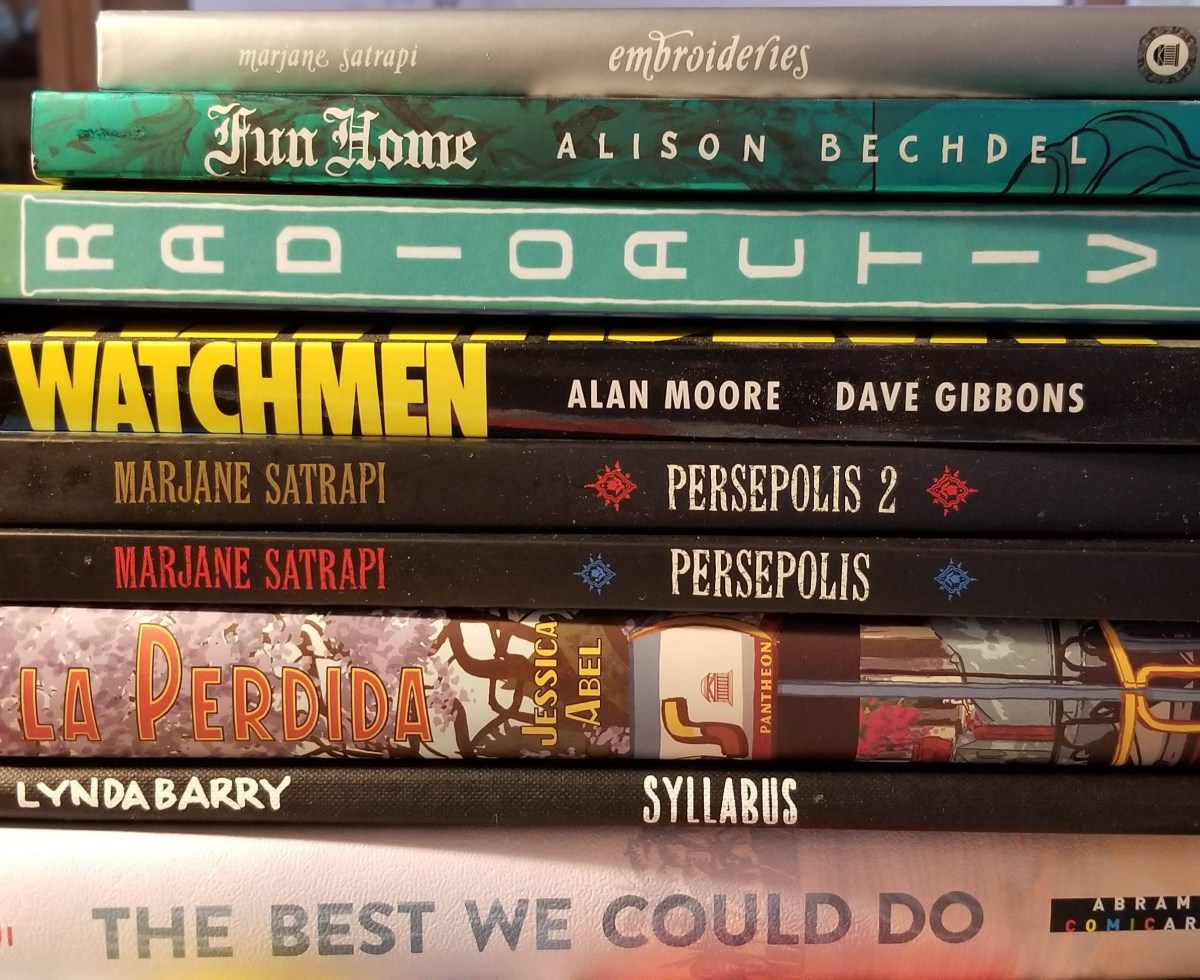
Other graphic novels have certainly handled complex and challenging stories. With visual elements emphasizing concepts that would be lost in pure text formats, the graphic novel is a powerful medium for difficult narratives. The images of water in Thi Bui’s The Best We Could Do, the laughter and faces of the women in Marjane Satrapi’s books; the cityscapes in Brian Selznick’s Wonderstruck or Jessica Abel’s La Perdida–these novels present personal narratives, visual and textual, some autobiographical, all beautifully drawn, hilarious, scary, fun, and heart-breaking.

But the form can also powerfully transform the presentation of technical material. In Radioactive, Lauren Redniss not only combines biography, history, and science education, she accomplishes this using a format that pays homage to the work of her subject, Marie Curie. By turning to drawings on cyanotypes, the work references the photographic exposure that was critical to the discovery of radiation. Its physical form is an important element in how the book is able to convey its story.

At UW-Madison, the cartoonist Lynda Barry is using drawing to explore the creative process with not only artists, but scientists. Her students have created the Applied Comics Kitchen, but there are also other efforts in visual science communication around Madison, such as JKX Comics.  It’s amazing, fascinating stuff. This is not just about images, these are explorations into different kinds of stories and story-telling.

lyndabarry_syllabus1

It is exciting to see compound productions like this–graphic novels and theater,  storytelling that is both visual and physical. The combination of text and image, music and communication, it’s an interdisciplinarity that is so powerful. I’m not talented enough to ever be as moving and charismatic as Karen Olivio and the two younger actresses I saw in the role of Alison, but few people ever really get to that level. I do, though, think about story-telling, about how to explore and better represent complex narratives. I’m not sure my answers will necessarily involve singing (actually, I am quite certain they will not), but there are so many other forms available. A wide-ranging consideration is an important place to start.

 

Fair Rosalind

Rosalind is always better when she is disguised as Ganymede. The recent closing night of APT’s production of As You Like It proved it once again as Melisa Pereyra’s ease and charm stretched all the way through the pouring rain to reach even the ushers seated in the last row.

I love this play. It is not the I die, you die, we all die experience of Hamlet or other of Shakespeare’s tragedies. Instead, this play has bad poetry plucked from trees; banter between fools, shepherds, and melancholy philosophers; beautiful language, songs, and famous lines; a cross-dressing heroine; and a convenient wrap-up at the end.

When Rosalind sheds her feminine garb and appears as Ganymede, she/he just has so much damn fun. Ganymede is all experiment and exploration. He tests and prods, feeling what is possible. He is the very force of creation; he is the edge, the gray area, the liminal place where inventiveness resides. But he is, at the same time, Rosalind. It is really she (in disguise) who is the explorer, the mad scientist, the inventor, the instigator. And I love her for it.

The Path
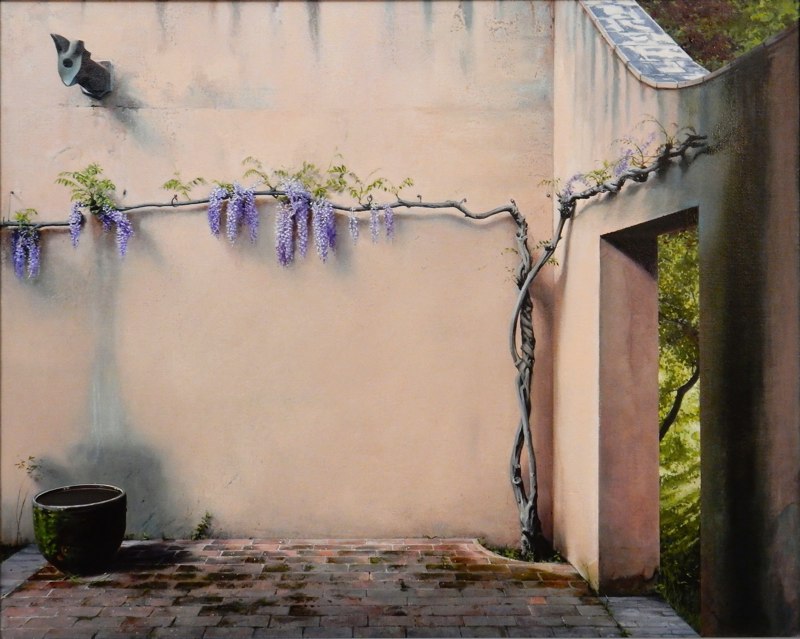
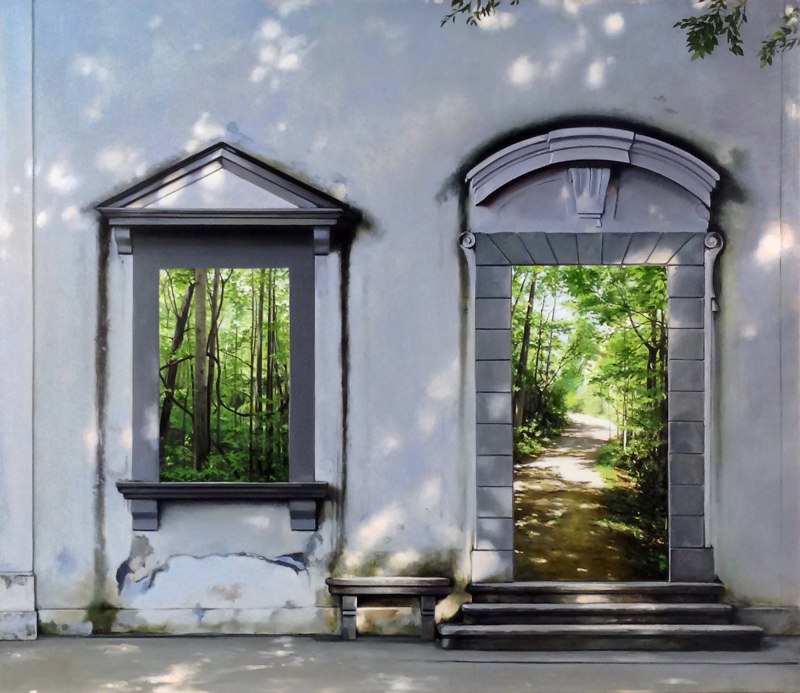
Carol Pylant, The Path (oil on aluminum)

As You Like It rests easily in works by the Wisconsin and Chicago-area painter, Carol Pylant. Her courtyards are so still, populated only occasionally by stray dogs or peacocks. The spaces are quiet, with stone flooring and archways, plastered walls, signs of age but of indeterminate, and thus suspended, time. But these spaces, so beautifully rendered in mind-boggling detail, open onto disparate landscapes of green forests and wooded paths, sunlight and trees, overgrown but inviting. Rosalind waits against the stone wall in the spare courtyard, but Ganymede runs off into the distant woods, his feet nimble among the roots and uneven paths.

Artigas Spring
Carol Pylant, Artigas Spring (oil on linen)

The boundary between the formal and the unkempt, the ordered and the wild, the confined and the free, is so clearly represented in this work but cannot be neatly comprehended. The paintings are unsettling because of this very disconnect: the spaces don’t match. The constructed courtyards that open to unstructured wilderness are too close, too accessible. In their very realism the paintings proclaim their place in the imaginary, as when the audience lets itself believe that Rosalind could ever be taken as Ganymede. The painting is its own referent; the play’s the thing.

Before the End
Carol Pylant, Before the End (oil on aluminum)

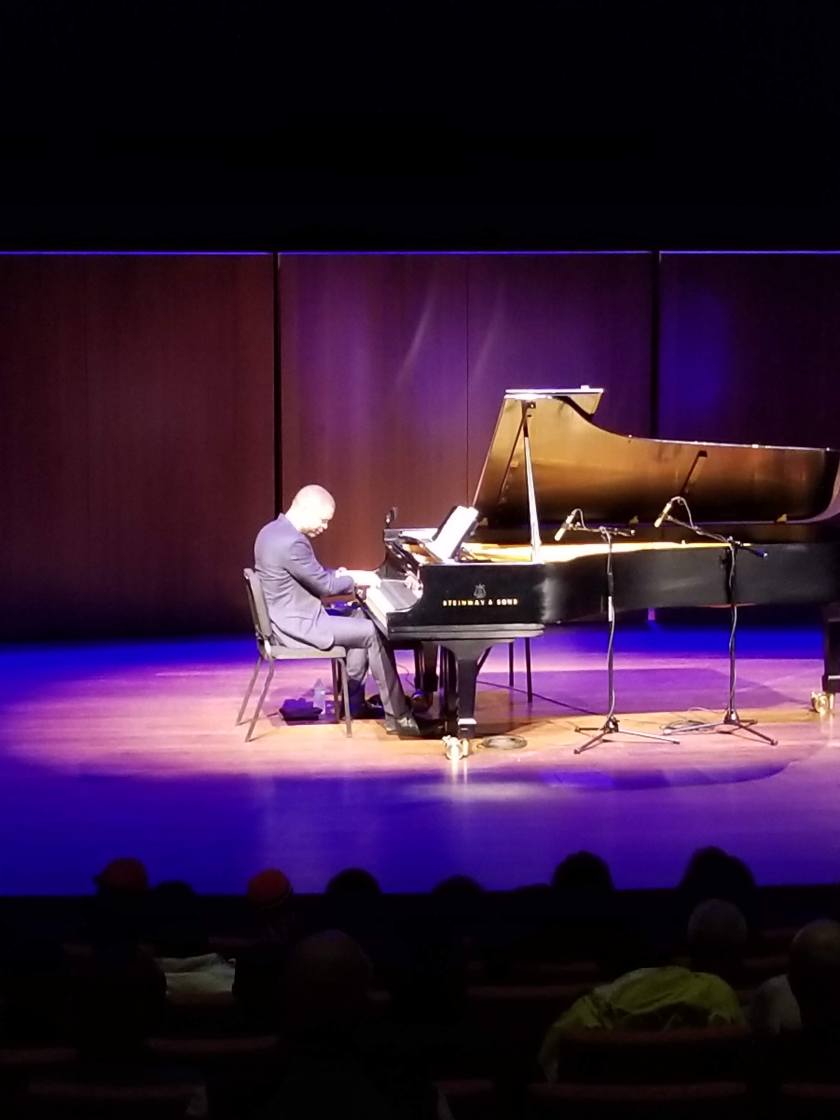
But sound is also the thing, especially when it’s Jason Moran playing piano at the Hyde Park Jazz Festival. There’s piano, and then there are the sounds that Mr. Moran creates. The rumbling, so quiet at first, building slowly until it fills my head, forcing out any other thought, requiring, demanding, clear, sole focus on the sound itself. Sound that split the world of piano into two: what I had known before, and what I understood after. The former was the constructed world, the courtyard where Rosalind sits attired in her courtly manners, suspended in time, waiting. The latter is possibility: the overgrown, tangled woods where Ganymede freely uncovers love of all kinds.

20180930_205602
Jason Moran: Celebrating Willie Pickens & Muhal Richard Abrams. Logan Center Performance Hall, September 30, 2018.

Soothing balm for difficult days? Maybe, but the music, the paintings, and the play all embody the quintessential dichotomy of court and green world, the opposition between constrained manner and unfettered potential. Luckily for viewers and listeners, there is a space where characters shed expected behaviors and take on new identities, where music is released into sound, where buildings open into wilderness, offering up a celebration of creativity and imagination, the joy of discovery, the release of constraints, and the pleasure of making something new.

(Update: Carol Pylant’s work will be featured in an exhibition during spring 2019 at Gallery Victor Armendariz in Chicago. A publication, Carol Pylant: Portal Paintings, 2009-2019, will accompany the show, featuring essays by me and Buzz SpectorDetails will be shared about the catalogue and the exhibition as soon as they are available!).

Represent

My project from last fall, in conjunction with planning for some upcoming exhibitions, is making me think more about abstraction and representation: if these terms are useful and where they are relevant. Complicated words, they each have multiple layers and definitions that vary by context.

Chloë Bass has considered abstraction, wondering if it is a privilege, but concluding instead that it is essential for bringing people together. This approach is relevant, not only to my exhibition of Dan Ramirez’ work, but it speaks to many other recent exhibitions that focus on or unearth or explore the work of artists of color working in abstract, minimalist, or non-representational visual styles. How are these approaches interpreted by museums?

That is, of course, if there is actually any work by artists of color in the museum to be interpreted. It seems that some museums have finally caught on to the imbalance of their collections. But what will they do with the work once it has been purchased and accessioned? Will it go into storage with the other 92-98% of the collection? Will it stay there for 20 years without being researched or interpreted?

(When I say “interpret,” I mean display. When a museum displays a work of art it is interpreted: selected, installed with other works within a larger scheme or organizational structure, lit and labeled, accessible during open hours, for an admission fee or not, under electronic or human surveillance, climate controlled, documented, stanchioned, managed by museum etiquette like do not touch or no flash photography please, hash-tagged, pictured on posters and greeting cards in the shop, nicknamed, examined, and seen by hopefully very many people. Adding text in the form of a label or a docent tour or a curator talk or an audio file or a web exhibition is an additional layer of interpretation. The museum identifies the work with artist, title, date, medium, and credit line, which is interpretation. If you don’t agree, have you ever asked an artist about the date when a work was completed, the title of a work, or whether they used graphite or pencil? The answers that make it onto the label are interpretation).

Rashid Johnson has talked about how representation of the Black body has offered a way into museum spaces for Black artists. (I would say this goes for Latinx artists too. Figurative work by artists of color is easier for white curators because it is clearly identifiable as culturally-specific. Maybe images of cholos, madonnas, or sharecroppers are easier for marketing teams, too?) But what about artists who do not work in representational modes? If Sam Gilliam’s detachment of canvas from stretcher can be understood within a history of protest–in Johnson’s words, as “emancipation”–is this dichotomy, representational and abstract, useful at all?

Such limited terms obscure similarities and suggests a non-existent conflict. For example, when artists are interested in perception, in creating work that unsettles our understanding of what we see, is there only one path available? Is it either, or? Of course not. Both Dan Ramirez and Faisal Abdu’Allah make art work that questions how we make sense of what we see, and their work and practices could not be more different.

Ramirez’s approach is unapologetic. He is not interested in discussing his latinidad, damn it, he is applying paint to canvas or graphite to wood, and thinking about our ability to understand the world. He plays perceptual games using geometry and light, surface and depth. The play is deeply connected to philosophical pursuits, along with his considerations of belief and doubt. His work makes you question what you see.

Abdu-Allah’s approach is figurative and community-based; he uses photography, printmaking, weaving, and other media to represent gatherings of people. FauHaus and Visage were collaborative projects, developed in partnership with groups of students. But his objects also refer to groups of people: a gold barber’s chair standing in for the important sociality of the barber shop.

His two Last Supper tapestries picture groups of people also, but what is represented is not easily read. The iconography has been mixed up—the typical Eurocentric Christian Last Supper is transformed here with women and Muslims, or contemporary dress and a display of weapons. Not only is the imagery changed, but the medium has undergone an alchemical transformation from photograph to Jacquard tapestry, playing again with the Eurocentrism of the title. These works make you question what you see.

If the display of Ramirez’ Aletheia: Scribe’s Reveal was a dramatic statement about the artist’s career and aesthetic vision, Duppy Conquerer is Faisal’s own coming out. Using imagery that is forthright and insistent, this is a loud and clear assertion of himself as an independent artist within an international art world. With a nod to his Jamaican heritage and an I-don’t-have-time-for-your-shit stance, in black clothing and mask, he is a story-teller and magician, mentor and scholar. He represents. And yet, with photograph transformed into tapestry, individual into icon, the work makes you question what you see.

Perception is a tricky thing. Michelle M. Wright calls this interaction between work and viewer the “physics of Blackness”:

In any given moment, when the spectator engages a work of art, different valences of Blackness may formulate, expand, or multiply, qualitatively and quantitatively. What is Black art? That may very well depend on the time and the space of the moment.

So, how do museums interpret the work of Black or Latinx artists? Representation and abstraction are complex terms that indicate what happens when the viewer is engaged. What is it that you think you see? That’s the question.