Notes on working with an artist in 2013

It is a rare thing to encounter another Humboldt State University alum, as I live in Wisconsin. But one week in 2013 was different, when my work at the Chazen Museum of Art on the campus of the University of Wisconsin-Madison actually brought a fellow lumberjack into town.

Michael Lucero (Art, 1976, a solid ten years before me, Art, 1986) lives in Tennessee. His art-making has taken him from California and undergraduate studies at HSU to an MFA at the University of Washington. He has lived in New York and Italy, and has taught as a visiting professor throughout the United States, such as a 1989 summer arts program at HSU (I attended the summer 1988 session, missing Michael’s stint by one year). His ceramic work was featured in a 1996 retrospective exhibition organized by the Mint Museum that traveled to four venues, including the Smithsonian’s Renwick Gallery of the National Museum of American Art.

Michael was in Madison to install a body of early work in the Chazen’s 5,000 square foot Rowland Galleries. During the installation we had a chance to talk about Humboldt and studying art. I was so pleased to learn that he remembered people I studied with at HSU: Ron Johnson in art history, and Mort Scott who taught sculpture. Michael also had many stories about his experiences in the galleries of New York and his friendships with well-known artists, teachers, and dealers.

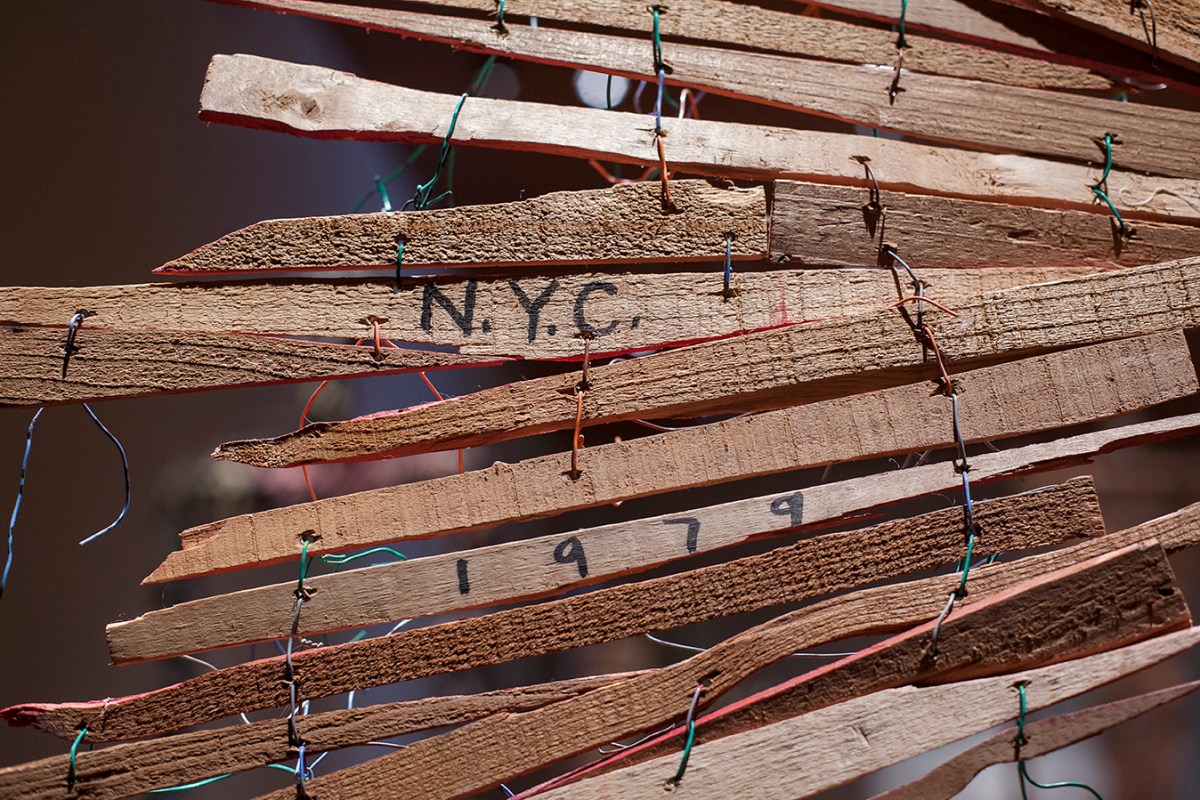
During the week we worked with the Chazen preparators to install 17 wire and wood hanging figures, made in 1978-79 after the artist first moved to New York. The works were on loan from a private collector, and two museums that received part of the Dorothy and Herbert Vogel Collection: New Jersey’s Montclair Art Museum, and the Portland Museum of Art in Maine.

IMG_7583
Michael Lucero Installation, Chazen Museum of Art, 2013

Reaching 8-13 feet in height, the figures are simultaneously fragile and imposing. Hovering just a few inches from the floor, they hung still when the gallery was empty, but they moved gently, responding to subtle air movement, even when anyone entered the room. They towered over whoever stood near, yet provided a chance for close investigation of their component parts: broken wood, crayon and paint, wire, mop handles, and broken furniture scavenged from the streets of the city.

The artist created new drawings for the exhibition, using sponges, fly swatters, shoes, toilet paper rolls, and foam noodles to stamp images onto cardboard, making bold, weighty figures that reference the hanging sculptures. He was also inspired by the gallery space, at the last minute adding a new work to the exhibition: two monumental figures stamped directly onto a large gallery door that had been painted to mimic the cardboard of the drawings. At first seeming so large, the drawings on cardboard were dwarfed by the newly painted wall figures, yet their textured surfaces demanded close looking. This was an installation both overwhelming and intimate, it played with scale and had so much to experience: subtle movement, shifting light, interesting textures, and spatial displacement.

IMG_7589
Michael Lucero Installation, Chazen Museum of Art, 2013

In the re-purposed wood and furniture fragments, in the drawings made from available materials, is Humboldt evident in this work, or is it all New York City? In the quiet of the towering figures with their slight movements, walking among them all that is missing is the sound of water dripping into the ferns on the floor of the redwood forest. Maybe, or not. But it was fun, for one week in 2013, to conjure a connection between Arcata and NYC, to swap art world stories with another far-flung HSU alum, and participate in the installation and documentation of a truly wonderful body of work.

Michael Lucero Installation was on view May 11 to August 18, 2013 at the Chazen Museum of Art at UW-Madison. Photos by Eric Tadsen.

 

Represent

My project from last fall, in conjunction with planning for some upcoming exhibitions, is making me think more about abstraction and representation: if these terms are useful and where they are relevant. Complicated words, they each have multiple layers and definitions that vary by context.

Chloë Bass has considered abstraction, wondering if it is a privilege, but concluding instead that it is essential for bringing people together. This approach is relevant, not only to my exhibition of Dan Ramirez’ work, but it speaks to many other recent exhibitions that focus on or unearth or explore the work of artists of color working in abstract, minimalist, or non-representational visual styles. How are these approaches interpreted by museums?

That is, of course, if there is actually any work by artists of color in the museum to be interpreted. It seems that some museums have finally caught on to the imbalance of their collections. But what will they do with the work once it has been purchased and accessioned? Will it go into storage with the other 92-98% of the collection? Will it stay there for 20 years without being researched or interpreted?

(When I say “interpret,” I mean display. When a museum displays a work of art it is interpreted: selected, installed with other works within a larger scheme or organizational structure, lit and labeled, accessible during open hours, for an admission fee or not, under electronic or human surveillance, climate controlled, documented, stanchioned, managed by museum etiquette like do not touch or no flash photography please, hash-tagged, pictured on posters and greeting cards in the shop, nicknamed, examined, and seen by hopefully very many people. Adding text in the form of a label or a docent tour or a curator talk or an audio file or a web exhibition is an additional layer of interpretation. The museum identifies the work with artist, title, date, medium, and credit line, which is interpretation. If you don’t agree, have you ever asked an artist about the date when a work was completed, the title of a work, or whether they used graphite or pencil? The answers that make it onto the label are interpretation).

Rashid Johnson has talked about how representation of the Black body has offered a way into museum spaces for Black artists. (I would say this goes for Latinx artists too. Figurative work by artists of color is easier for white curators because it is clearly identifiable as culturally-specific. Maybe images of cholos, madonnas, or sharecroppers are easier for marketing teams, too?) But what about artists who do not work in representational modes? If Sam Gilliam’s detachment of canvas from stretcher can be understood within a history of protest–in Johnson’s words, as “emancipation”–is this dichotomy, representational and abstract, useful at all?

Such limited terms obscure similarities and suggests a non-existent conflict. For example, when artists are interested in perception, in creating work that unsettles our understanding of what we see, is there only one path available? Is it either, or? Of course not. Both Dan Ramirez and Faisal Abdu’Allah make art work that questions how we make sense of what we see, and their work and practices could not be more different.

Ramirez’s approach is unapologetic. He is not interested in discussing his latinidad, damn it, he is applying paint to canvas or graphite to wood, and thinking about our ability to understand the world. He plays perceptual games using geometry and light, surface and depth. The play is deeply connected to philosophical pursuits, along with his considerations of belief and doubt. His work makes you question what you see.

Abdu-Allah’s approach is figurative and community-based; he uses photography, printmaking, weaving, and other media to represent gatherings of people. FauHaus and Visage were collaborative projects, developed in partnership with groups of students. But his objects also refer to groups of people: a gold barber’s chair standing in for the important sociality of the barber shop.

His two Last Supper tapestries picture groups of people also, but what is represented is not easily read. The iconography has been mixed up—the typical Eurocentric Christian Last Supper is transformed here with women and Muslims, or contemporary dress and a display of weapons. Not only is the imagery changed, but the medium has undergone an alchemical transformation from photograph to Jacquard tapestry, playing again with the Eurocentrism of the title. These works make you question what you see.

If the display of Ramirez’ Aletheia: Scribe’s Reveal was a dramatic statement about the artist’s career and aesthetic vision, Duppy Conquerer is Faisal’s own coming out. Using imagery that is forthright and insistent, this is a loud and clear assertion of himself as an independent artist within an international art world. With a nod to his Jamaican heritage and an I-don’t-have-time-for-your-shit stance, in black clothing and mask, he is a story-teller and magician, mentor and scholar. He represents. And yet, with photograph transformed into tapestry, individual into icon, the work makes you question what you see.

Perception is a tricky thing. Michelle M. Wright calls this interaction between work and viewer the “physics of Blackness”:

In any given moment, when the spectator engages a work of art, different valences of Blackness may formulate, expand, or multiply, qualitatively and quantitatively. What is Black art? That may very well depend on the time and the space of the moment.

So, how do museums interpret the work of Black or Latinx artists? Representation and abstraction are complex terms that indicate what happens when the viewer is engaged. What is it that you think you see? That’s the question.


Celebrating Connection

Lucas_Koehler_Combo
Lucas Koehler Combo, Union Hair Parlor, ALL Jazz Fest 2018, Schenk’s Corners.

On top of a recent realization about some professional fails, mostly surrounding communication and an inability to see clearly, the other day I took 10 minutes and three trips down the hall to print one shipping label. This was yet another clear failure: too much time to complete a (usually) simple task.

As failures go–especially when compared to the rest of the day’s realizations–the label printing was relatively low-impact: a time-waster and frustrating, but that’s about the extent of the damage. Luckily the day ended with some local jazz: #thebestjazzisinhairsalons fully expresses the restorative, rejuvenating, community experience that provided me with much-needed perspective and release after a difficult week.

Of course there are other failures, some of remarkable scale, with a much much larger impact that can’t be remedied by jazz, no matter how awesome the music. A highlight of my difficult week was the opportunity to hear from someone who headed up one such spectacle, Jim Lasko of the now-closed RedMoon Theater. In a conversation with the Chazen’s director, Amy Gilman, Jim talked about the social impulse of his theater work which, at RedMoon, took the form of taking theater into the neighborhoods and streets of Chicago, in his words, “engineering new ways of being together.” The motivation was to make theater more accessible and bring performance to bigger, different audiences.

But Jim was not at the art museum to talk about street theater. He was invited because of what has been identified as a massive fail: the Great Chicago Fire Festival of 2014. I won’t rehash the story here, as it has been amply covered elsewhere–Jim has even talked and written about the event and the aftermath. I am more interested in his process of recovery, how he moved forward, and his perspective on creative work.

Jim talked of theater as a living activity, he compared it to a group jumping out of an airplane. With opening night the equivalent of the ground quickly approaching, the group has to work together intensely, and fast, to prevent disaster. The joy and excitement is in that process of making, of attempting and failing and trying again. It is thrilling, it is inspirational. We make art because we have to, we are driven to keep attempting it over and over. We fail every day, which is an important thing to remember as we get up and try again. But aside from the daily face-plants, in the wake of massive fail, what makes us pick up the pieces and try it again?

After the closure of RedMoon, Jim says he talked to many people about his next steps. He talked about failure to corporate groups, and he returned to work on an unfinished PhD. Recently he teamed up to open a new maker and gathering space called GuildRow.

After the presentation I was able to ask Jim about the recovery, the aftermath. He had talked about it in personal terms in the conversation on stage, but I wanted to know how his team responded, and how they, as a group, recovered after hitting the ground so hard. After some thought he revealed something about the theater company that was striking: he said they worked through the difficulties because they loved each other. A company like RedMoon that was dedicated to bringing theater outside, into neighborhoods, and making it participatory, this company was comprised of intensely committed individuals who fiercely loved their work. They ran on a personal devotion to shared goals and to each other. This is not, of course, every organization. But it seems completely reasonable, maybe even necessary, for a non-profit street theater group.

I am intrigued that Jim emphasized the personal in his presentation. He was not there to talk about failure. His comprehension is contrary to the corporate lingo approach to failure which, through it’s focus on venture capital, minimizes and even erases the personal–the pain and suffering, the lived experience, the frustration, anger, and confusion. But in Jim’s telling was a sense of a community, not only within the active theater company, but following the disaster. He described turning to his personal community to assess and advise, to consider and imagine. This was a way of doing important individual work, human work. It is restorative, it is personal, and it is vitally important.

Which takes me to a different theater project that I was lucky to witness recently, here in Madison. Lines: A Theatre LILA Invention is a collaboratively written play that gives voice to five female playwrights of color. The play was a complex intertwining of stories, with actors playing multiple roles. The beauty of the play was not only in the acting, the staging, and the direction, but in the stories that were told. These are voices that are rarely heard in theater: beauty shop conversations, playground interactions, hopscotch, hope for the future, lovers’ arguments, the daily dangers of being a woman, black, lesbian, latina, muslim, young, or even middle-aged.

It was a play that conveyed the personal, but also emphasized the importance of connections and the potential of community, not only in how the play was created or what was represented on stage, but in the conversations with the audience that followed. This is the same force behind Jim Lasko’s theatrical efforts: a desire to connect. In moving performance outside into the street, or by collaboratively developing a script with other writers of color, these efforts expand the reach of theater. They breathe in deeply and open their arms, inviting more people into their embrace. They grow the audience.

Although connections can be uncomfortable, as with some of the questions that were asked during the talkback after the Lines performance, or in the direct personal challenges that were issued during the play, they are essential for the success of art making. I imagine that for some people, like those who enjoy the anonymity of a dark theater, RedMoon’s street performances would have been quite difficult. But connection takes many shapes. Engagement may be a buzzword, but we use it for a reason. Lasting impressions–wonder–happens when people are able to connect, with each other, with art, with music, with something outside of themselves.

These theater efforts are so different, yet both relied on the very personal dedication of their members. Understanding this devotion and commitment transforms notions of success and failure. A fizzled public art event is insignificant when the connections created through it, or the exhibition of an artist’s work, a collaborative theater event, or even a jazz celebration (pictured above), are prioritized. Instead of focusing on failure, maybe it’s is more important to foreground engagement and connection, and their restorative, sustaining potential. Who did you connect with today? We fail daily, but so do we achieve. Connecting every day, staying engaged, that’s the hard part. But when it happens? Wow.